 USA + International
 OWC Canda
 OWC Europe
Tested Under Pressure: OWC Atlas Pro Cards Save Serious Time in a Late Night TV Production Pipeline
A rigorous field test proves the time-savings provided by the OWC Atlas Advantage storage pipeline.
Wayne Grayson • Jun 23, 2026
In the most rigorous production environments, time is everything. And any piece of gear that can give you more of it is extremely valuable. As a result, when hard deadlines loom, your gear has to perform. Camera, memory cards, card reader, storage, computer—every piece of your workflow is a vital link in a chain that isn’t doing its job if it’s adding stress to your workflow, slowing it down, or at risk of failing altogether.
One of the most rigorous production environments period is Late Night TV. Beyond the near ceaseless writing and planning that goes into one of these shows, the clock resets every weekday. And each night, somewhere between the live taping and broadcast, multiple teams scramble together to assemble loads of footage and photos that will support and promote that main broadcast. And these assets end up going out to millions more that the original broadcast reaches thanks to social media and the internet at large.
So, we asked a simple question: how much of the success of that time-sensitive nightly workflow is decided in the first few seconds—at ingest of the footage and photos? And how much of it can a purpose-built workflow and pipeline get back? To find out, we ran a field study putting the OWC’s Atlas pipeline to the test in a real late night TV production environment, logged it to the millisecond, and published the math.
For just over two weeks, photographer Todd Owyoung, a 20-year veteran of live-performance and concert photography, a Nikon Ambassador, and the staff photographer for The Tonight Show Starring Jimmy Fallon, logged every memory card he ingested as part of his normal routine at the show, capturing exact times using Photo Mechanic’s import logs. The cards in the study included the OWC Atlas Pro CFexpress Type B card as well as competing cards.
The results? The OWC Atlas Advantage is very real. Throughout the study, the Atlas Advantage Pipeline gave Owyoung serious amounts of his time back with each ingest when compared to other memory card and storage solutions.
Before we get into the full results, Todd’s participation in this study doesn’t constitute an endorsement of OWC products, and NBC’s production environment is not a marketing partner here. The purpose and benefit to OWC of this study was to place our products smack in the middle of a high-stakes, time-sensitive imaging workflow under real production pressure, instead of measuring synthetic benchmarks. In fact, we wrote a full white paper, complete with a rundown of the process, findings and math that went into them. Because the only way to make a claim like “we give you your time back” credible is to show your work.
The Atlas Advantage: A Fully Integrated Storage Pipeline
Here’s the thing: efficiency in a production pipeline is never the result of one component. To get meaningful amounts of time back from offload and ingest, you need a fully integrated chain of gear.
That’s why OWC has designed Atlas memory cards and readers to seamlessly integrate with our external storage solutions like our Envoy SSDs—and it’s why this study didn’t test a memory card in isolation. It tested a full storage chain:
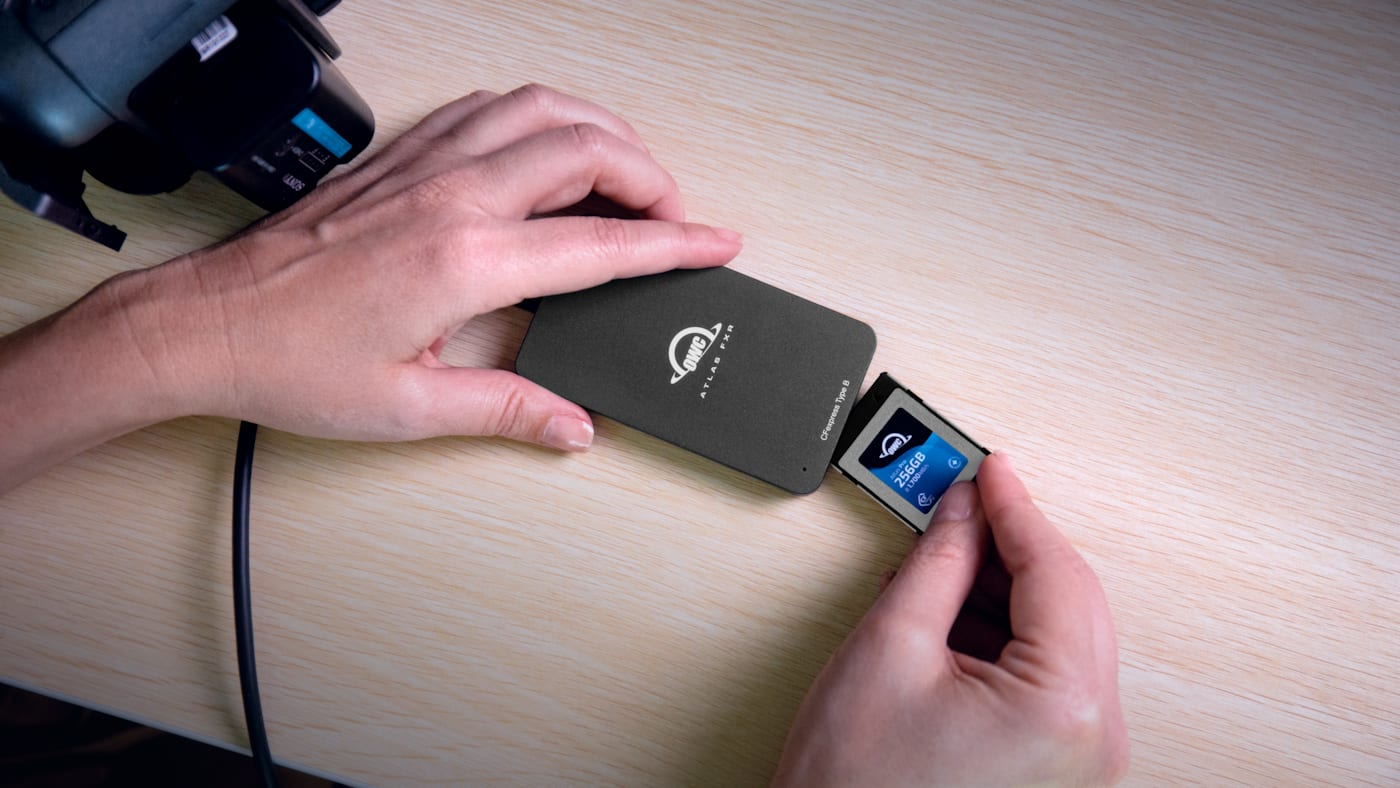
- Memory cards: An OWC Atlas Pro CFexpress Type B card along with competing cards from other brands.
- Card reader: The cards were ingested through an OWC Atlas FXR Reader, plugged into a Mac Studio and running through Photo Mechanic for log recording.
- Storage: All the cards were offloaded onto an OWC Envoy Pro Elektron SSD.
Rather than report raw transfer speed (MB/s), the study measures seconds per gigabyte (sec/GB) — the one metric where time required and time saved share the same units. Lower is faster. And because it’s linear with volume, it converts directly into something useful: if you’re ingesting 215 GB a night and you save half a second per gigabyte, you’re just a hit of multiplication away from determining t he real value of these solutions: minutes back.
The Workflow
A typical production night on The Tonight Show for Owyoung includes five to seven segments: monologue, a sketch or game, two or three interviews, music in between, and maybe a musical act. These are shot across three camera bodies dialed in for different lighting. After every segment, Todd runs the cards to his editor for an immediate ingest and pre-selection. “It’s no exaggeration to say seconds count in this role,” he noted.
And ingest is just the starting gun. From there, images move into a half-dozen parallel paths almost simultaneously: the show’s digital team building social posts on a 9:30–10:00 p.m. cadence; guests’ promo teams pushing “tune in tonight” content; and syndication through Getty reaching outlets like Rolling Stone, Vanity Fair, and Vogue, often before the episode has even aired.
Every one of these pieces is dependent upon the same first step: getting the images off the card.
What the Data Showed
The study quantified exactly where the time spent on ingest goes and how the Atlas Pipeline claws crucial seconds back.
The card matters
Over 15 qualifying days, new Atlas Pro CFexpress Type B cards averaged 0.53 seconds per gigabyte faster than the non-OWC comparison cards — a result that held up not just across thousands of individual ingests, but when the team re-ran the analysis card-by-card to rule out one fast card skewing the average.
The chain matters more.
But maybe the most telling result wasn’t even planned as part of the study — it was an accident. On one night, Todd’s ingest target SSD, the OWC Envoy Pro Elektron, was unintentionally swapped for a competitor’s drive. Every single card offload slowed down, OWC included, by 30–45%.
While it's important to note that the speeds recorded with this accidental swap were not included in our formulation for total time savings over the study, that doesn't mean the results gathered from this accidental SSD swap aren't valuable. For starters, we found that even with the data coming off the cards going onto a slower SSD, the OWC Atlas Pro cards remained 10% faster than the competition—another clear win for Atlas. But more importantly, this finding reinforces not only that card selection matters, but also that the full benefit of a card depends on a fully optimized storage chain. In fact, our findings show that if you choose the wrong drive to offload onto, the penalty of that choice can sometimes negate any speed you gain by investing in a faster card.
This is the cleanest evidence in the study for our fully integrated Atlas pipeline philosophy: the memory card is where the Atlas Advantage begins, but it isn’t where it ends.
The time adds up fast.
Scaled across a 160-episode season at Todd’s average nightly ingest volume, switching to Atlas Pro cards translates to roughly 5 hours of ingest time saved over the season — time that doesn’t just belong to the photographer. It belongs to everyone in the queue behind him.
Why a Half-Second Is Worth Caring About
Seconds per gigabyte sounds like a rounding error until you remember who’s waiting on the other end of it. Every minute reclaimed at ingest is a minute returned to an editor doing a second pass, a digital producer hitting a social window while the moment is still hot, or a guest’s team getting ahead of their own promotional clock. As the white paper puts it, the savings “cascade down the production’s workflows." And over a season, small per-ingest gains compound into hours that show up exactly when they’re worth the most: late at night, under deadline, with multiple teams waiting to move.
Read the Full Study
While this post covers the basics of this study, the full white paper covers the receipts: confidence intervals, hypothesis tests, a full audit trail back to the raw Photo Mechanic logs, and a Q&A section addressing exactly the kind of methodological questions a skeptical reader should ask.
Download the full OWC Atlas Advantage Pipeline white paper (PDF) to dig into the numbers yourself.
Other topics you might like

How NRG Recording Studios is Bringing its Historic Archive Into the Modern Era
Updated on Sep 22, 2026
OWC SoftRAID 9 Brings RAID 6 Protection to Mac and Windows, Introduces RAID 6+
Updated on Sep 21, 2026
How to Maximize Your New M5 Max and M5 Ultra Mac Studio: Storage, Docking, and Connectivity
Updated on Sep 16, 2026