USA + International
 OWC Canda
 OWC Europe
The Best Compact Cinema Camera in 2026: Canon R6V, Canon C50, Nikon ZR, and Sony FX2 Compared
When it comes to capturing cinematic video in a compact riggable package, there are more fantastic options than ever. Here's how to chose the best compact cinema camera for you.
Wayne Grayson • May 21, 2026
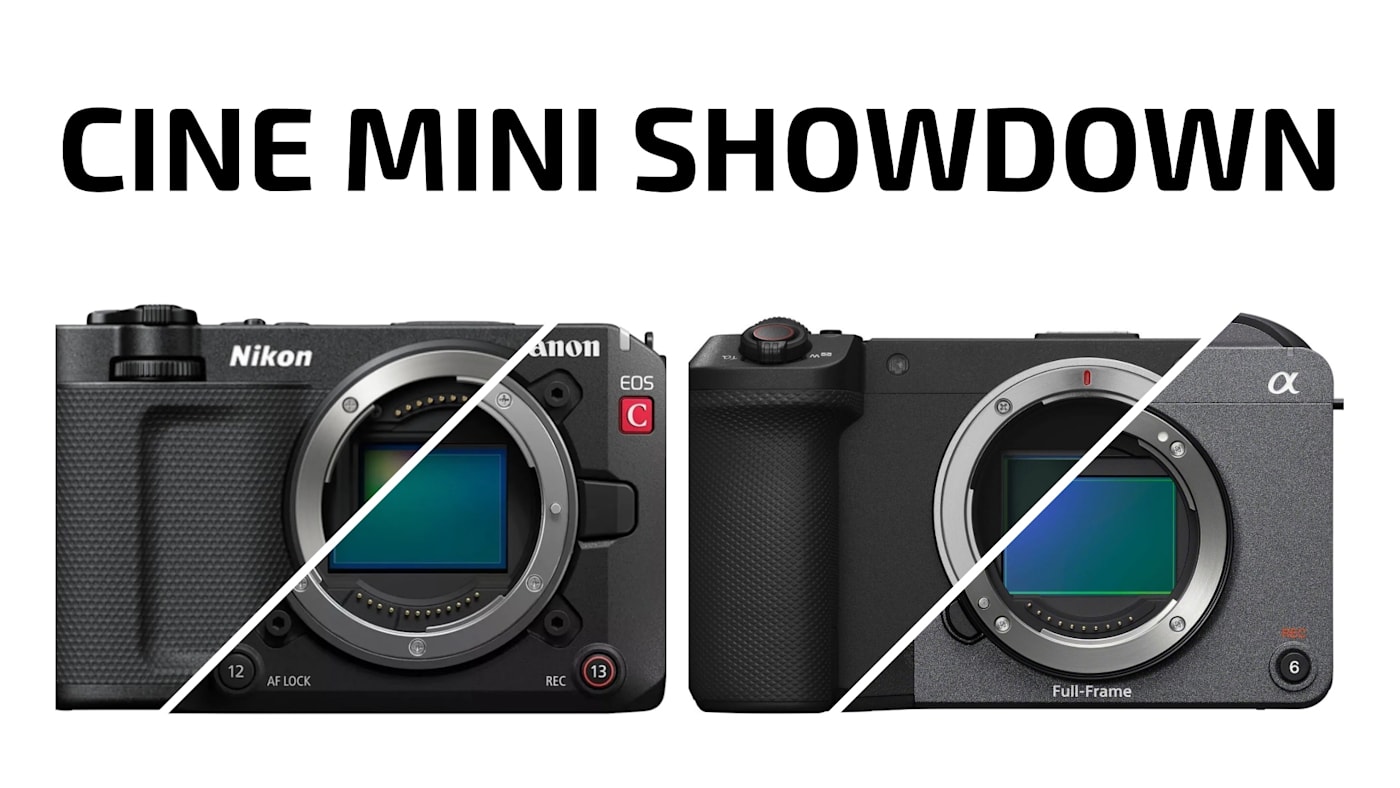
Over the past year, a new segment of the camera market has taken shape and is growing increasingly crowded: compact, creator-focused cinema cameras. First came the Sony FX2, announced in the spring of 2025. Then, the Canon C50 and Nikon ZR were announced within days of one another in in the fall of that year and were followed by the Canon R6V in the spring of 2026.
Each of these new compact cinema cameras blur the line between consumer mirrorless and dedicated cinema camera and each makes a slightly different bet on what video-focused creators actually need. Canon's newly announced EOS R6V is the latest entrant, and its arrival makes this a good moment to take stock of the field.
Here's how the R6V stacks up against the Canon EOS C50, Nikon ZR, and Sony FX2—four cameras that overlap in price and purpose but differ considerably in what they prioritize.
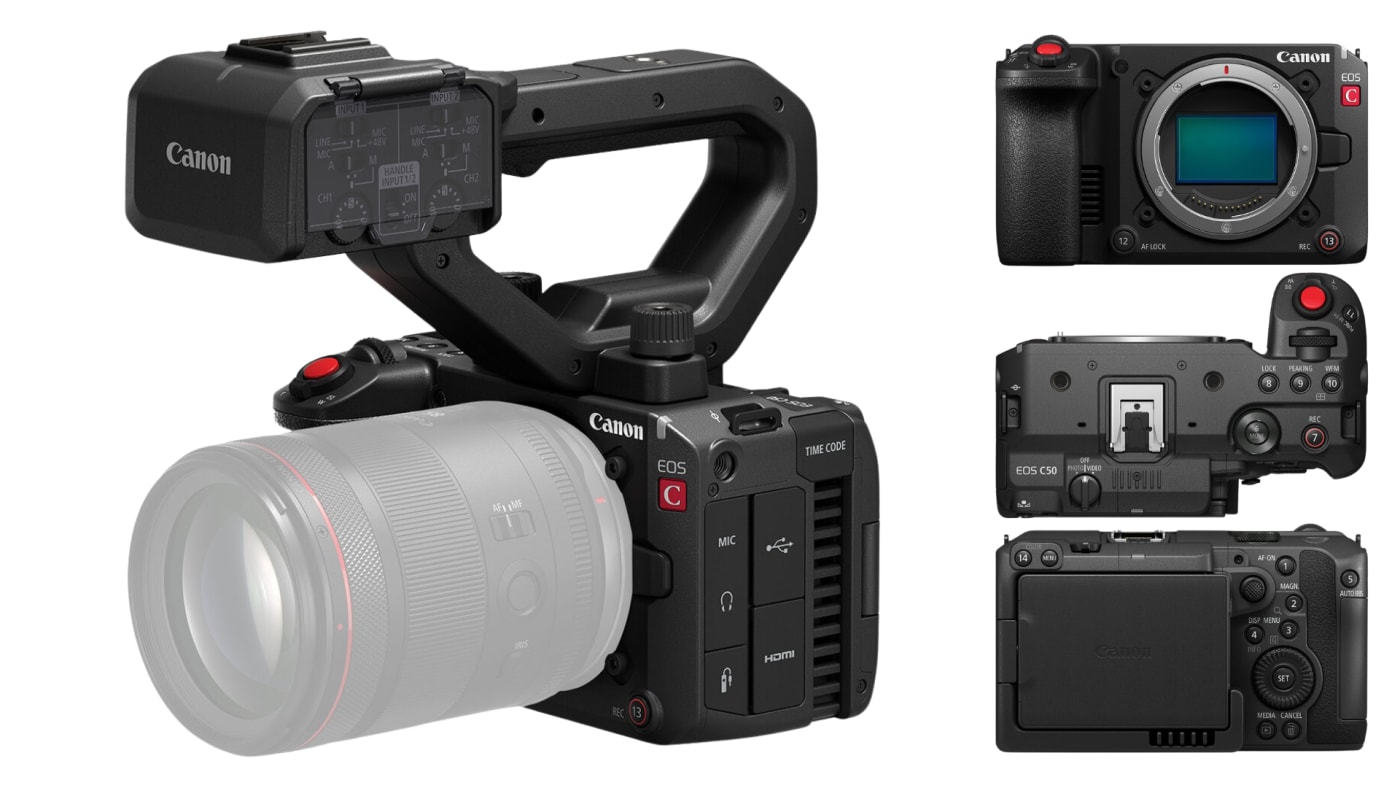
Canon EOS C50 ($3,899): The Professional Cinema Tool
The C50 is Canon's most compact Cinema EOS camera to date, and the clearest professional filmmaking option of the four. It shares the same 32.5-megapixel full-frame sensor as the R6V but runs the Cinema EOS menu system—a significant distinction for shooters coming from professional cinema workflows. It records Cinema RAW Light up to 7K/60p internally, supports XF-AVC and XF-HEVC S codecs, includes native Frame.io Camera-to-Cloud integration, and ships with a detachable top handle that adds two full-size XLR audio inputs.
What the C50 gives up relative to the other three cameras is in-body image stabilization. That’s an omission that anyone who plans to use this camera either handheld or on a gimbal in any meaningful capacity may not want to cope with.
The C50 is also the most expensive of this compact cine group by a significant margin. For shooters building a traditional cinema rig around a professional workflow, the C50 makes a strong case. For solo creators who prioritize mobility and flexibility, that $1,000+ premium over the R6V and the rest of the field is a harder sell.
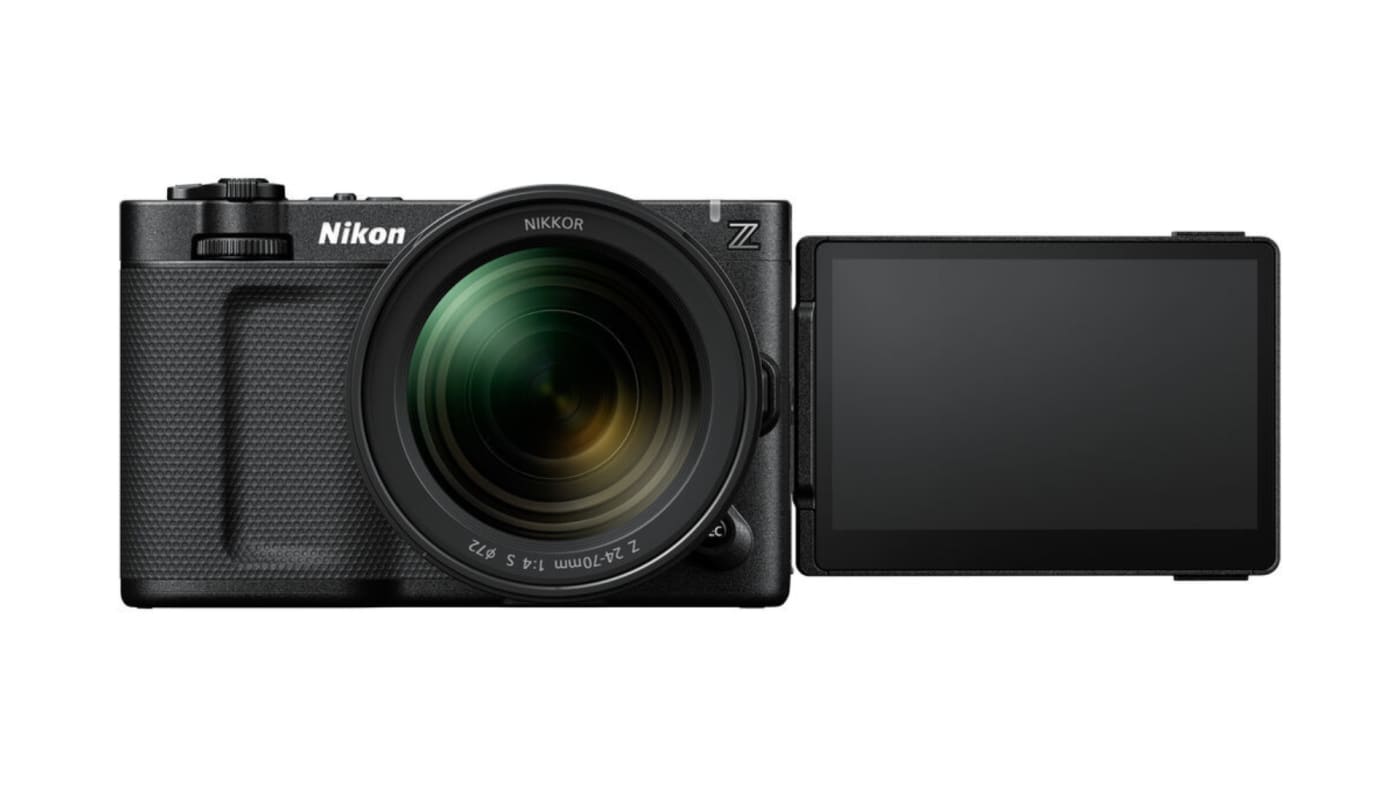
Nikon ZR ($2,199): RED Color Science in a Compact Body
The ZR was a surprise when Nikon announced it parallel to the Canon C50 at IBC 2025. It’s Nikon’s first cinema camera developed in collaboration with RED Digital Cinema following Nikon's 2024 acquisition of the company. And for its price point this is an insanely stacked cinema camera.
Built around a 24.5-megapixel partially stacked full-frame sensor shared with the Nikon Z6 III, the ZR records up to 6K/60p with N-RAW, R3D NE (Nikon's variant of REDCODE RAW), and ProRes RAW options. It delivers 15+ stops of dynamic range and includes 5-axis IBIS rated to 7.5 stops.
But the ZR's real standout features are its big, beautiful, 4-inch, 1,000-nit DCI-P3 touchscreen—the largest on any mirrorless camera—in-camera 32-bit float audio recording, and RED color profiles. And again, you get all of this at a price that undercuts all three competitors.
The ZR isn’t perfect though. Trade-offs include passive cooling only (no internal fan), which can limit recording times in some environments; a microSD secondary card slot that feels like a budget compromise; micro-HDMI rather than full-size; and no open-gate recording. The 24.5MP sensor also trails the 32.5MP Canon sensors and Sony's 33MP chip for stills resolution. (That said, there is growing sentiment among creatives that have adopted the ZR that it is an excellent camera for stills, delivering quality on par with the Z6 III. For more on its stills capability, watch this, this, and this.)
For indie filmmakers who want cinematic RED color science in a small package and are comfortable with a primarily manual cinema workflow, the ZR is remarkable value. Its price advantage is also hard to ignore as a B-camera option for RED users who want matching color science on a second body.
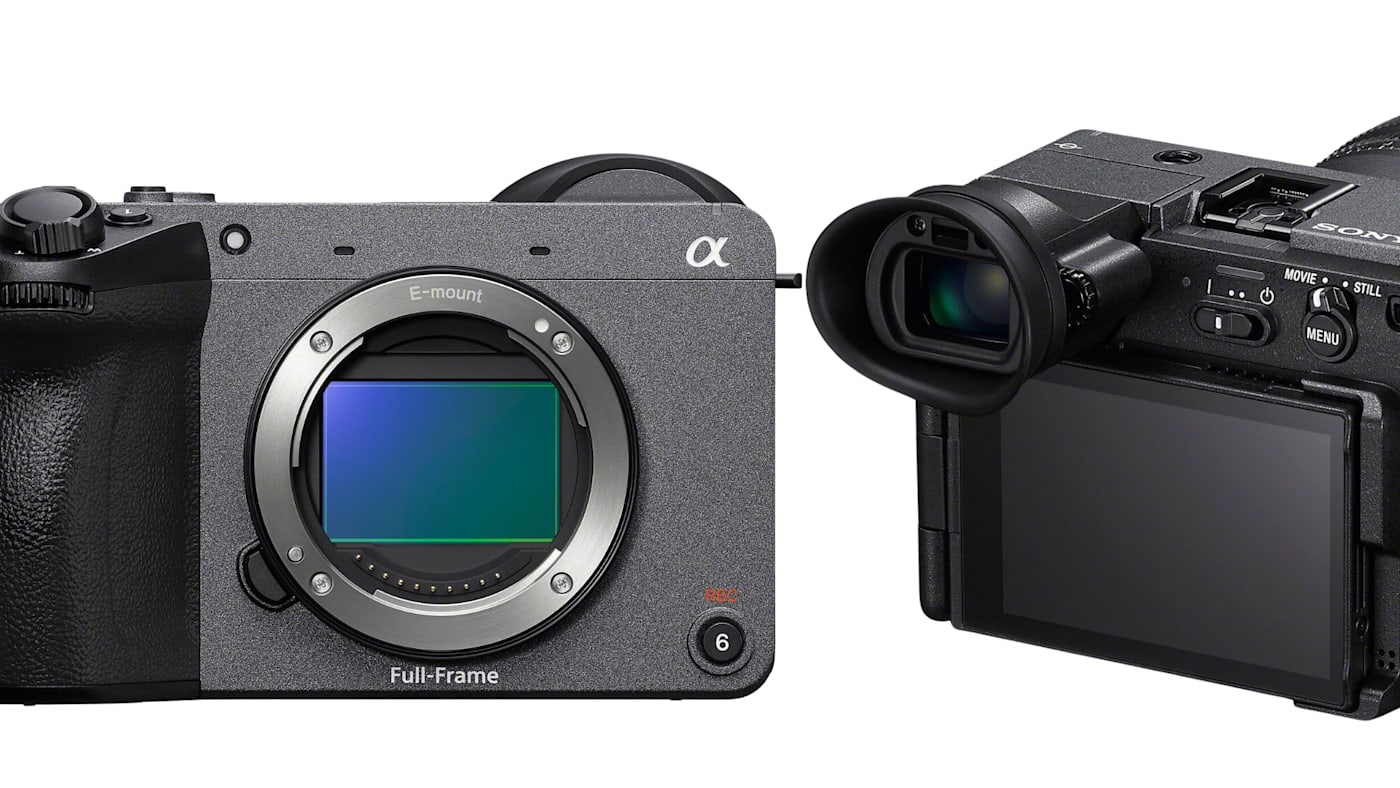
Sony FX2 ($2,699): The Hybrid That Kept Its Viewfinder
The FX2 occupies a different philosophical space than the other three. Where the R6V, C50, and ZR all traded away the electronic viewfinder in the name of a video-first form factor, Sony went the other direction. The FX2 is the first compact Cinema Line camera to include an EVF, and a tilting one at that. It's a meaningful differentiator for anyone who shoots stills seriously, works in bright outdoor conditions, or simply prefers an eye-level finder for precise framing.
The FX2 is built around a 33-megapixel full-frame BSI Exmor R sensor, a built-in cooling fan for extended recording, 5-axis IBIS, and Sony's class-leading autofocus system. It records 4:2:2 10-bit internally with S-Log3 and S-Cinetone color profiles, and outputs 16-bit RAW externally over HDMI. That last point is the key caveat: unlike the R6V, C50, and ZR, the FX2 has no internal RAW recording. External RAW output is also limited to a Super 35 crop at 4.7K — not the full-frame RAW option that cinema-focused shooters might want.
The other notable compromise is that 4K/60p requires a Super 35 crop. Full-frame 4K tops out at 30p oversampled, which is excellent quality but a limiting factor for shooters who need high frame rates at full field of view. For documentary work, interviews, branded content, and hybrid creators who shoot significant amounts of stills alongside video, the FX2 is a practical and well-rounded tool. For shooters who prioritize resolution, RAW workflows, or high frame rates, the limitations become harder to work around.
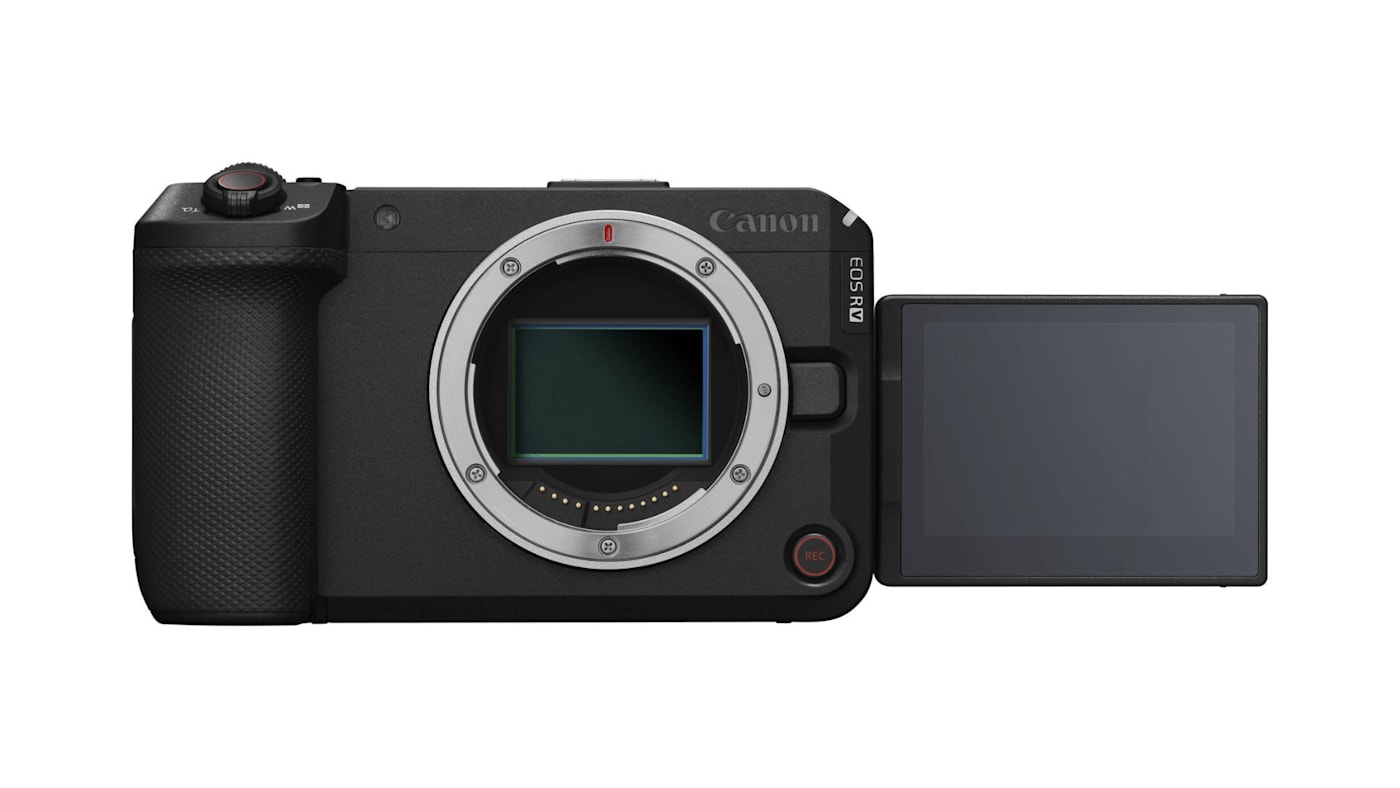
Canon EOS R6V ($2,499): The Video-First Mirrorless
The R6V is the newest of the four and the most deliberate attempt to split the difference between the professional cinema tool (C50) and the consumer-friendly hybrid (FX2). It uses the same 32.5-megapixel full-frame sensor as the C50, runs the familiar EOS R mirrorless interface rather than the Cinema EOS system, adds a built-in cooling fan with three selectable levels, and ships with a creator-specific feature set that includes a vertical tripod mount, a live-stream button, a tally lamp, and a zoom lever for the companion RF 20-50mm f/4L IS USM PZ lens.
The internal fan is the headline practical upgrade over Canon's previous consumer mirrorless bodies. Canon says 4K/60p recording at room temperature now runs approximately two hours—about four times longer than the fanless R6 Mark III. Open-gate 7K/30p, previously capped at 33 minutes, can now run as long as power allows. For creators shooting long interviews, live events, or documentary footage, that's a substantive improvement.
The R6V's key trade-off is the removal of the electronic viewfinder found on the R6 Mark III. Like the C50 and ZR, it's a screen-only camera. Unlike the ZR, it does not have a big, beautiful screen and is instead equipped with a 3-inch LCD. The electronic-shutter-only design also means some loss of dynamic range for stills compared to a camera with a mechanical shutter. For a video-first creator who doesn't rely on an EVF, those concessions are likely acceptable. For photographers who want genuine dual-purpose capability, the FX2's inclusion of a viewfinder starts to look more attractive.
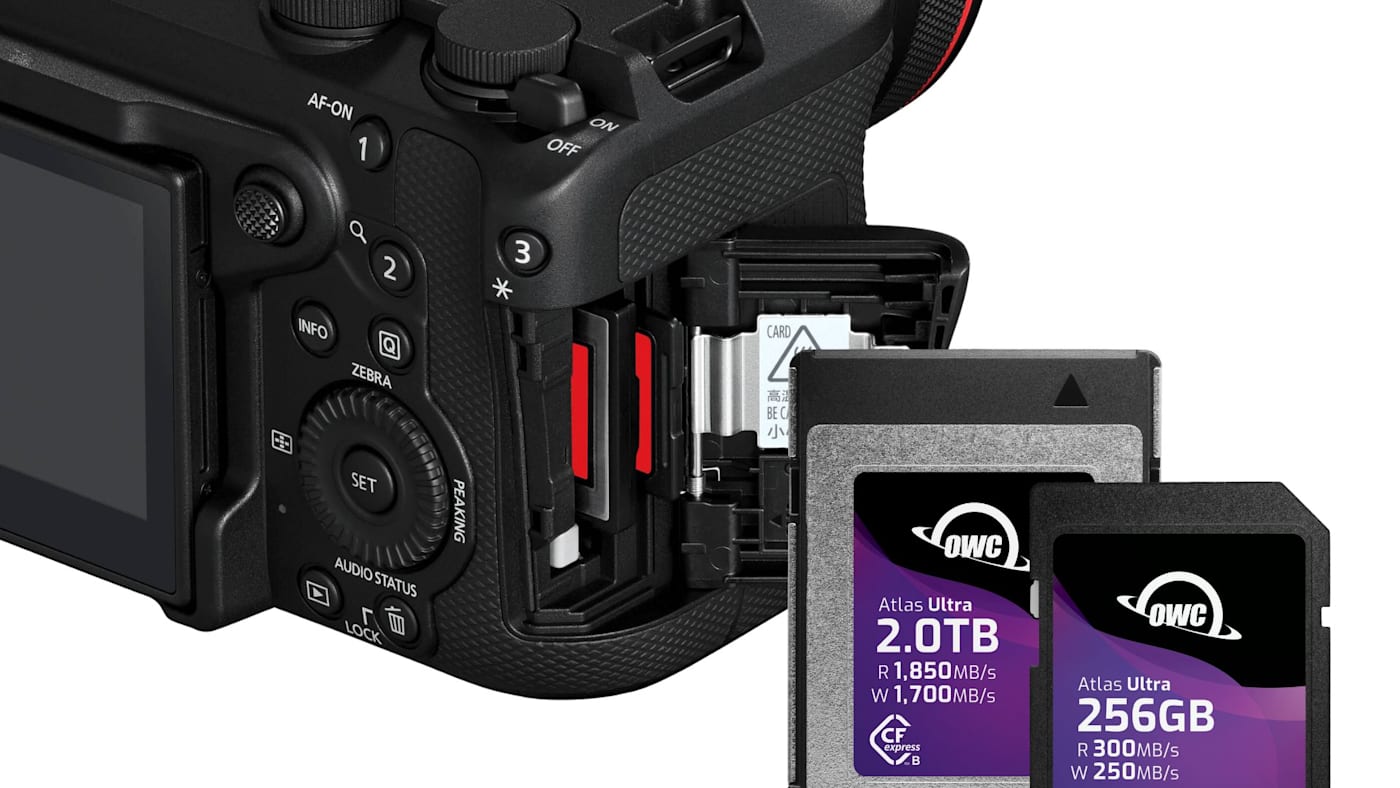
Storage Built for High-Resolution Video
All four of these cameras are capable of generating substantial amounts of high-resolution footage and the R6V, C50, and the NIkon ZR's RAW recording modes in particular demand fast, reliable media.
Three of these four cameras—the Canon EOS R6V, Canon EOS C50, and Nikon ZR — all rely on CFexpress Type B cards as their primary recording media, and with good reason. The high bitrates demanded by 7K Canon RAW, Cinema RAW Light, and R3D NE RAW footage require the kind of sustained write speeds that only CFexpress Type B can reliably deliver. For those cameras, OWC’s Atlas Ultra CFexpress Type B card is the top-end option, built for the most demanding RAW video workflows. Meanwhile, the Atlas Pro CFexpress Type B is a strong choice for shooters who want proven reliability at high sustained speeds but don’t shoot in the most demanding video formats and don't need the premium speeds of Atlas Ultra cards.
And for the Sony FX2, OWC offers the best CFexpress Type A value on the market.The OWCs Atlas Pro CFexpress Type A covers the FX2 with comprehensive, sustained performance no matter how you put that camera to use.
Getting footage off your cards quickly is just as important as capturing it reliably. OWC’s Atlas CFexpress Card Reader is a USB4 reader designed to take full advantage of the blazing fast speeds cards like the Atlas Ultra CFexpress Type B is capable of, ensuring that your offloads happen as quickly as possible. Plus, this reader handles both Type B and Type A cards—the latter via an included adapter—so regardless of which camera you’re offloading from, one reader handles the whole workflow at speeds fast enough to keep pace with the footage you’re bringing back from a shoot.
Once the footage is off the card, you need somewhere fast and reliable to work from. OWC’s Express 1M2 is a USB4 NVMe SSD boasting Thunderbolt 4-level speeds and designed for editing directly from an external drive—ideal for high-res video timelines that demand maximum throughput. For location and travel workflows, the Envoy Pro FX is a bus-powered, rugged, waterproof and dustproof Thunderbolt SSD that handles on-set backup and on-the-go editing without needing external power. And for shooters who need the highest sustained performance in a portable drive, the Envoy Pro Ultra delivers Thunderbolt 5 speeds in excess of 6,000 MB/s in a compact, waterproof and dustproof enclosure. Any of the three pair well with the cameras in this comparison, and with each other as part of a 3-2-1 backup strategy for protecting irreplaceable footage.
Check out OWC memory cards and readers here and learn more about our external storage solutions here.
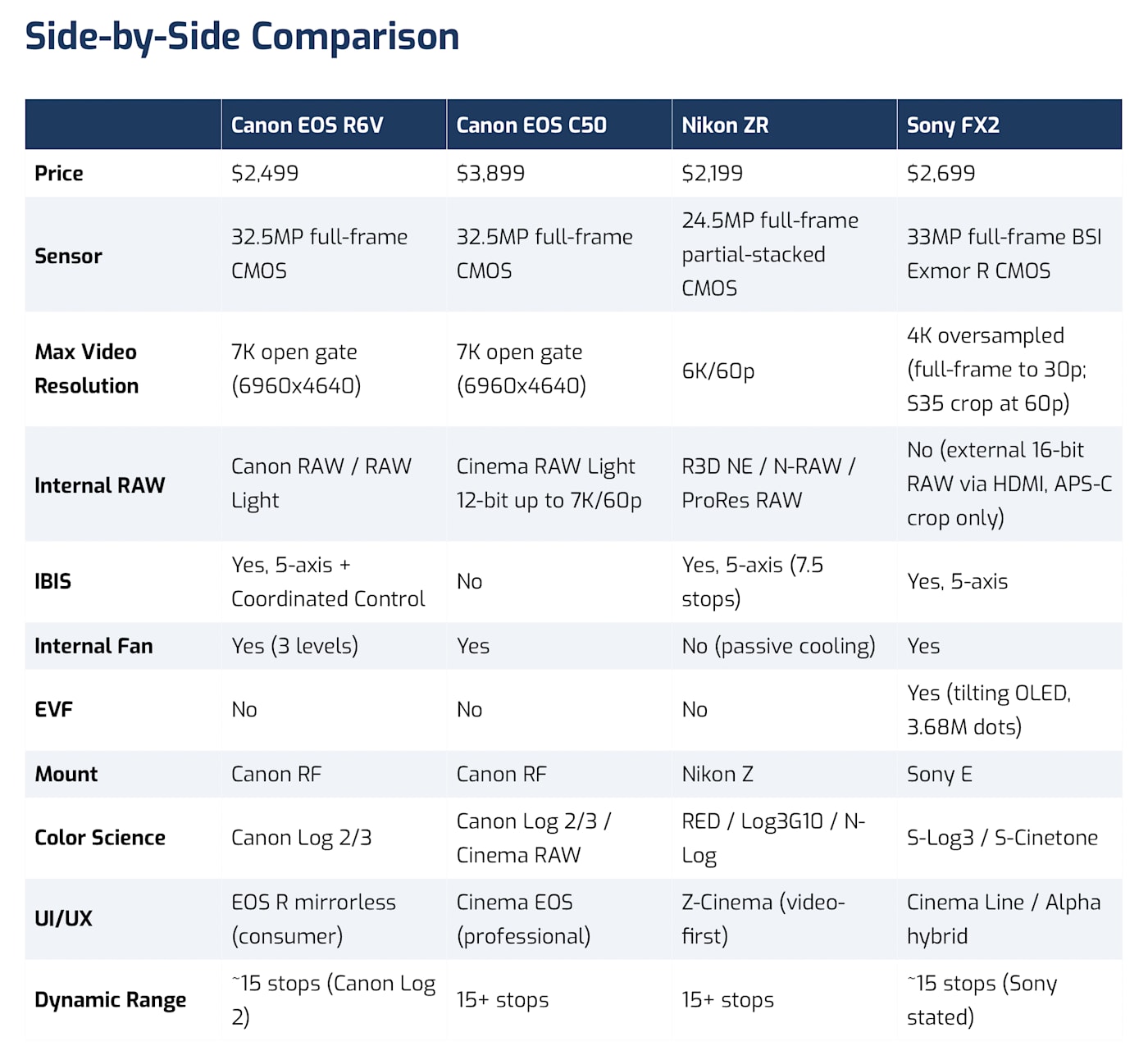
So Which One Is Right for You?
These four cameras are not interchangeable. They represent different priorities and the right choice depends on how you actually shoot.
Choose the Canon EOS C50 if:
- You need a professional Cinema EOS workflow, Frame.io Camera-to-Cloud integration, Cinema RAW Light recording, and XLR audio without a separate adapter.
- You're building a rig and the Cinema EOS interface matters to your pipeline.
- Budget allows for the premium price.
Choose the Nikon ZR if:
- RED color science is the priority — either for matching footage with other RED cameras or for the cinematic look in its own right.
- You want the most camera for the money and are comfortable with passive cooling and a more manual cinema-oriented workflow. The 4-inch display and 32-bit float audio are class leaders at this price and shouldn’t be underestimated, specifically the screen.
Choose the Sony FX2 if:
- You shoot a meaningful amount of stills alongside video and want an EVF. You're already in the Sony E-mount ecosystem.
- The Cinema Line color science and workflow matter to you, and you can live without internal RAW. The FX2 is also the strongest of the four as a traditional hybrid camera.
Choose the Canon EOS R6V if:
- You want maximum video flexibility in a consumer-friendly package—long recording times, open-gate 7K, strong autofocus, IBIS, and a creator-focused feature set—without stepping up to Cinema EOS pricing or a professional cinema workflow.
- The R6V is the most accessible of the four for creators who live in the EOS R ecosystem and want their camera to work as hard on a live stream as it does on a documentary shoot.
Other topics you might like

Godox's C100 is a Novel Light Meter and Mini Camera With a Transparent Display
Updated on Aug 5, 2026
Peak Design's Field Bracket is a Modular, AirTagged Evolution of the L-Bracket
Updated on Jul 28, 2026
Sony’s New FX5 Brings New Sensor, Open Gate, VENICE-level Features to a Compact Cinema Camera
Updated on Jul 23, 2026