 USA + International
 OWC Canda
 OWC Europe
Instantly Add Autofocus to Vintage Manual Focus Lenses With FotodioX PRONTO Adapters
Want the look of vintage glass with the ease of autofocus? FotodioX has just the adapter for you.
Wayne Grayson • Jul 08, 2026
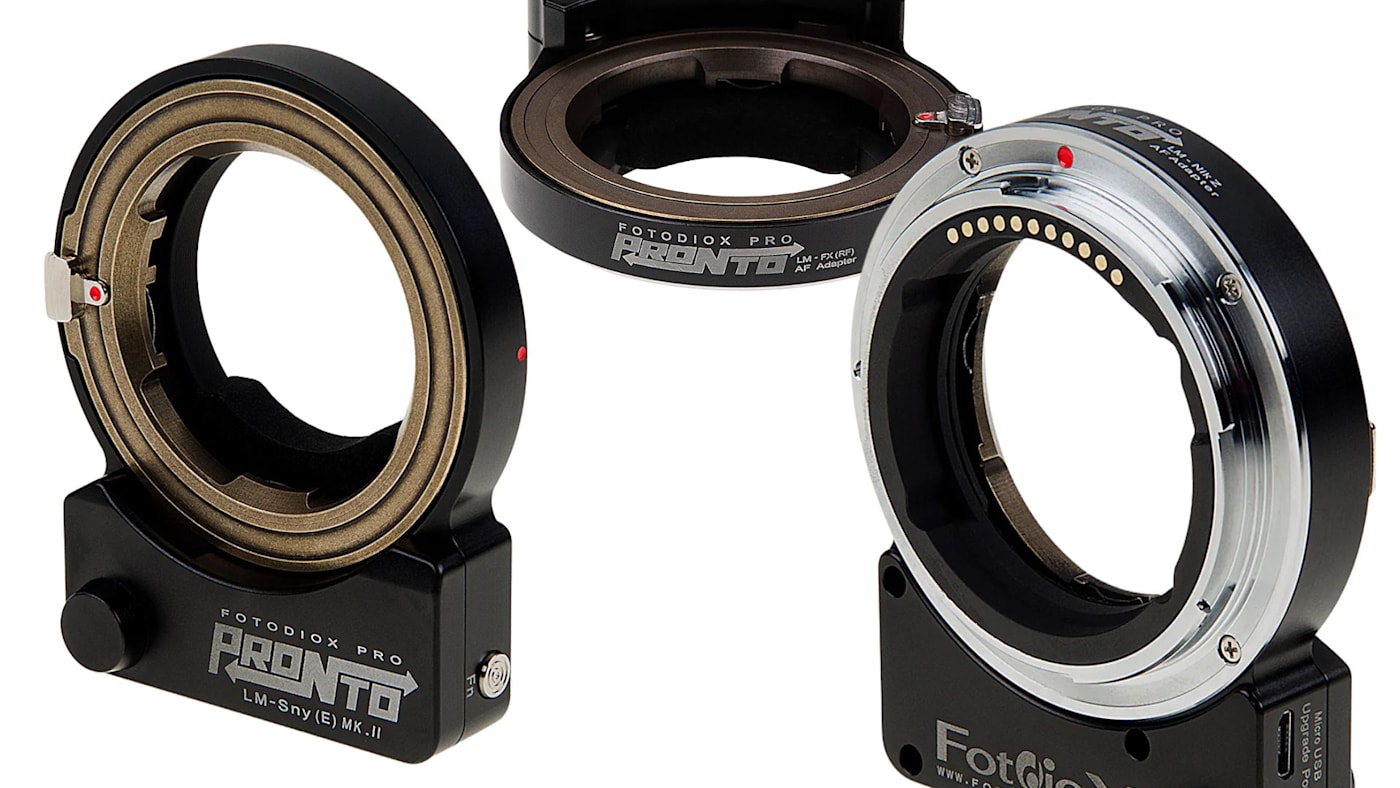
If you love the look of vintage glass but sometimes need the speed and flexibility of autofocus, the Pronto adapter system from FotodioX was built with you in mind.
These motorized adapters take M-mount lenses like vintage Leica glass or Voigtländer and Zeiss ZM optics and give them real autofocus on Sony E-mount, Nikon Z-mount, and Fujifilm X-mount cameras. And thanks to a growing family of companion adapters, M-mount isn't even a hard requirement. Pronto owners can extend autofocus to lenses from more than a dozen other legacy mounts through additional adapters.
How the Pronto Adapter Works
A Pronto adapter looks like a standard lens adapter, but has a small motor built into its body that is specifically designed for moving the entire lens mounted to it.
Instead of relying on the lens's own focusing helicoid, the adapter itself moves forward and backward, physically shifting the entire lens toward or away from the sensor to rack focus. The result is something that feels a lot like normal autofocus. Half-pressing the shutter button activates autofocus and the adapter drives the lens just like a native AF optic would.
On the Sony version, that shift range is up to 5mm; on the Nikon Z version it's the same 5mm, and on the Fuji version it's a slightly shorter 4.5mm of travel. FotodioX recommends setting the lens itself to infinity focus first, since that gives the motor the widest possible range to pull focus across.
So, the Pronto adapter is doing the focusing job a lens's own AF motor would normally do, just from the mount side rather than from inside the lens barrel. That's why it works with lenses that have no electronics at all.
Autofocus Performance and Limits
While this is a clever solution, because the adapter is shifting the entire lens back and forth to rack focus, there are some limits to the system.
For starters, FotodioX says that you can expect best results from 50mm and wider lenses; telephoto lenses may need a rough manual focus first, with the Pronto adapter doing fine-tuning via autofocus.
Also, weight matters. All three versions cap out around 1.3 lbs (600g) for the attached lens, since the motor has to physically move that mass back and forth.
There are also some autofocus mode support differences between the bodies to take note of:
- The Sony and Nikon Z versions support both AF-S (single) and AF-C (continuous) autofocus, plus face detection and image stabilization on compatible bodies.
- The Fuji version supports AF-S mode only — FotodioX is explicit that using AF-C mode on the Fuji adapter can damage it.
- On Sony, performance depends on the camera's autofocus system. Bodies with phase-detection autofocus (PDAF) — like the a7 II, a7R II, a9 II, a6500, and a6600 — perform best. Older contrast-detection-only bodies such as the original a7, a7R, a7S, and NEX-series cameras aren't recommended, and hybrid AF cameras may give inconsistent results.
Finally, a nice bonus is that the adapter can double as a macro tool: setting the lens to its closest focus distance turns the Pronto's extension into a built-in extension tube, shortening the minimum focus distance — an effect that's stronger on wider lenses.
A Few More Things Worth Noting on Typical Use
- The internal motor makes a small amount of noise while focusing, which FotodioX says is normal.
- The adapter can slowly drain camera battery even when the camera is off; removing the battery briefly when not in use prevents this.
- These are manual mount adapters, so lenses built for "focus-by-wire" systems — like Canon STM or Nikon AF-P lenses — won't be able to focus at all, since those need power from the camera body to turn their focus rings.
- Aperture is set manually on the lens itself; exposure is handled through the camera's aperture-priority (stop-down) metering mode.
- Each Pronto adapter carries an integrated function button that lets a photographer set the attached lens's focal length and maximum aperture, which helps the camera's autofocus system calibrate for that specific optic.
- All three versions ship with front and rear caps and a storage box, and are backed by a limited 2-year FotodioX warranty.
Beyond M-Mount: Adapting Other Lenses to Work with Pronto
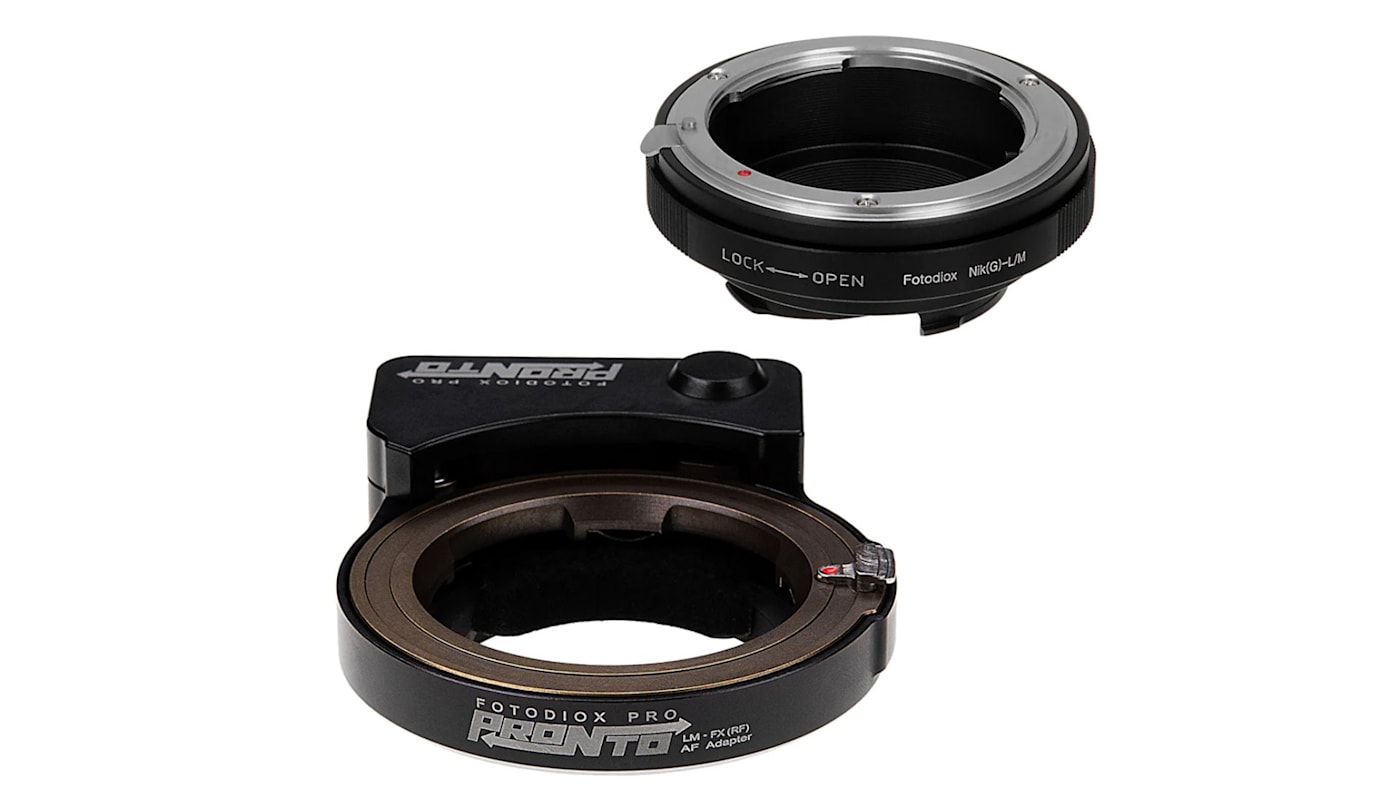
While each Pronto adapter natively supports M-mount lenses, Fotodiox doesn't expect everyone shooting with one to own only M-mount lenses. The company sells a separate line of mechanical adapters that convert other classic lens mounts to Leica M. Once a lens is in that M-mount adapter, it can be attached to the Pronto adapter and gain autofocus.
Fotodiox notes that not every M-mount adapter will physically clear the Pronto’s motor housing, so the compatible options are a curated subset of their full M-mount adapter catalog. The following mount-to-M adapters are confirmed to work with all three Pronto models (Sony, Nikon Z, and Fuji X):
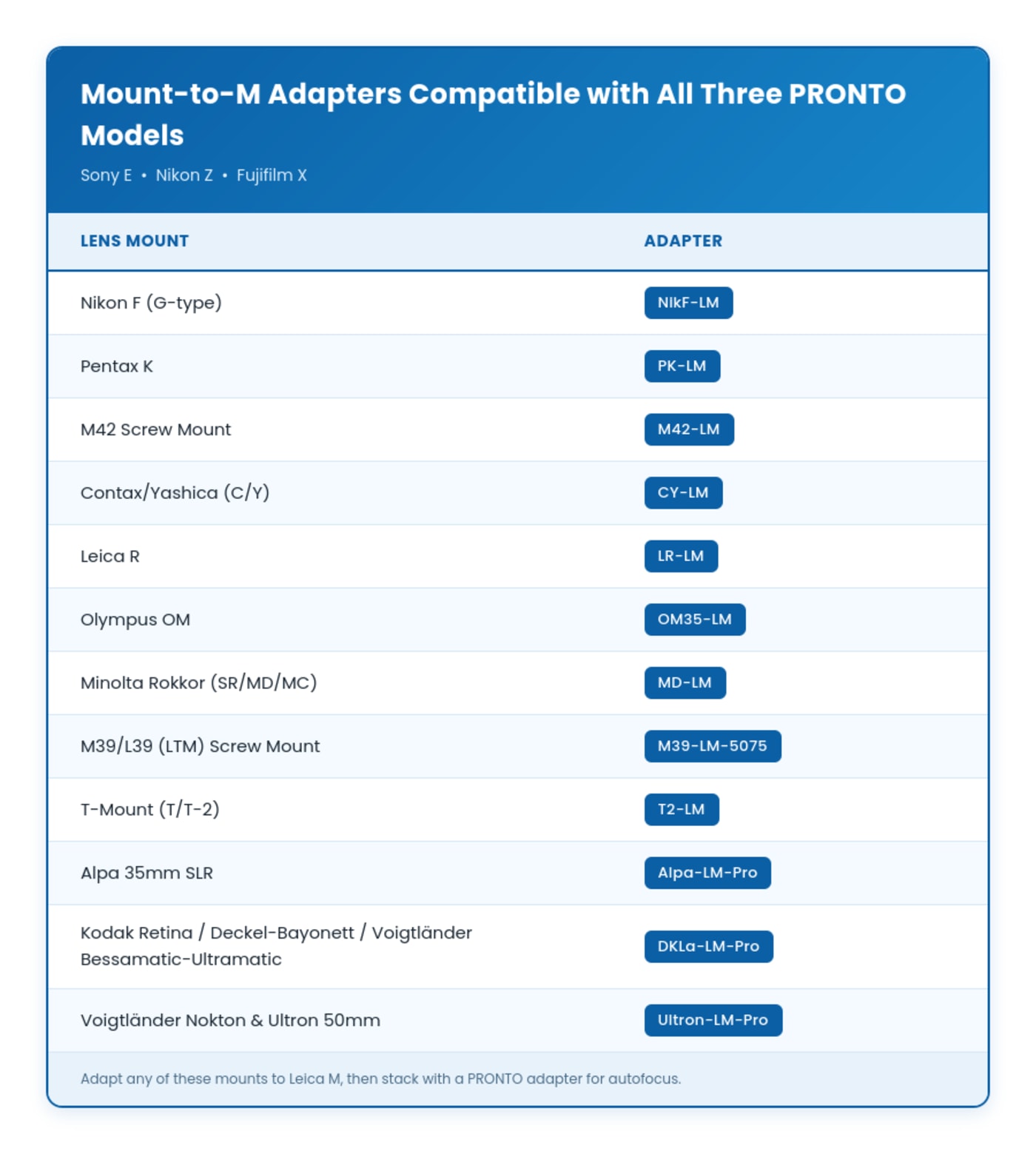
In practice, that means a lens sitting in a drawer with a Nikon F, Pentax K, M42 screw, Contax/Yashica, Olympus OM, Minolta SR, Canon FD-era Leica R, or even an Alpa or Kodak Retina mount can be brought into the same autofocus workflow as a native M-mount Leica lens just by stacking the appropriate mount adapter behind the Pronto.
One thing to Watch: Combined Weight
Stacking two adapters (a mount converter plus the Pronto) adds length and weight in front of the camera. FotodioX's weight limit for the Pronto motor is around 600g (1.3 lbs) for the lens itself, and that's easy to stay under with compact M-mount lenses. It gets easier to exceed once a second adapter and a heavier SLR or medium-format lens are added to the stack.
FotodioX's own testing suggests supporting the lens rather than the camera body when using a heavier combination, to keep strain off the mount and motor.
The Bottom Line
The Pronto system is a clever solution for anyone with a collection of manual-focus M-mount glass — or old SLR lenses from Nikon, Pentax, Olympus, Minolta, Contax, or elsewhere — who wants to shoot autofocus on a modern Sony, Nikon Z, or Fujifilm body.
For full compatibility lists, firmware updates, and instruction manuals, FotodioX maintains a knowledge base linked from each product page linked below:
Other topics you might like
Canon’s New RF 20-50mm f/4L IS USM PZ is its First L-Series Lens With Power Zoom
Updated on May 13, 2026

Find the Right Lens Faster With These Fantastic Field Made Indicator Lens Cap Labels
Updated on Apr 13, 2026
This Tilta Nucleus Autofocus Adapter and Motor Kit Can Modernize Your Vintage Lenses
Updated on Apr 1, 2026

We’re Digging This Blazar Lens Showdown Series That Helps Shooters Pick Their Favorites
Updated on Jan 29, 2026