 USA + International
 OWC Canda
 OWC Europe
From Everest to Baja to the Indian Ocean: The Built-in Durability of OWC SSDs is Trusted Every Day
Bumpers don't make a drive rugged. When it comes to durability and SSDs, it's what's inside that truly counts. These creators prove it every day.
Wayne Grayson • Apr 20, 2026
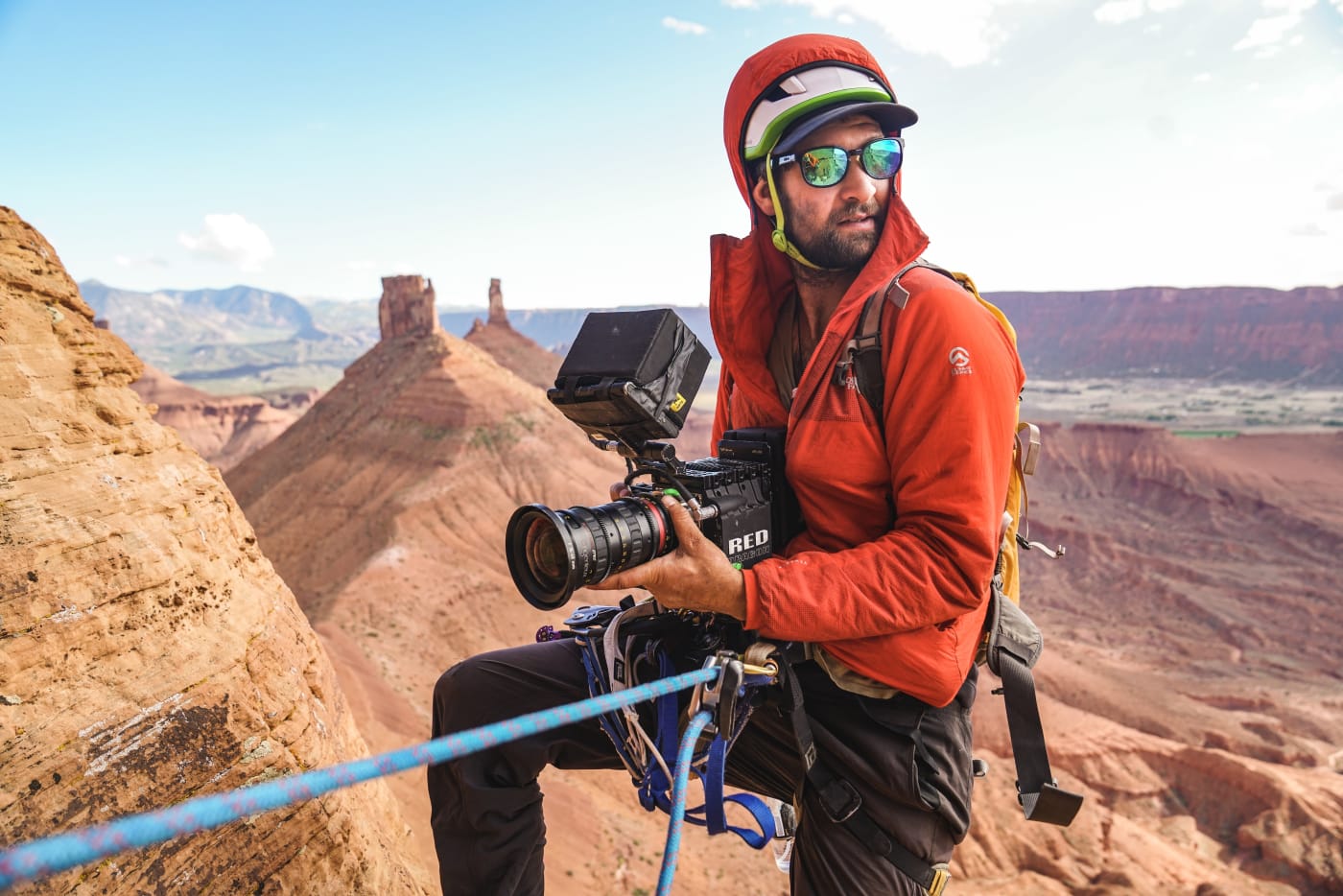
There really aren’t enough words to describe what Renan Ozturk does for a living. Photographer. Cinematographer. Documentarian. Landscape artist. Mountaineer. Climber. Adventurer. Expeditionist. All apply and all fall short of giving you the full picture of Ozturk and his many insane accomplishments.
Ozturk’s artistry has taken him to some of the world’s most beautiful and terrifying locales. He is maybe best known for the two ascents of the Shark’s Fin route that made he, Jimmy Chen, and Conrad Anker the first to summit Meru Peak in 2011, their journey documented in the film Meru, shot by Ozturk. In fact, I can’t think of another artist whose life I have feared for more in the process of watching their work than Ozturk. Whether it was overcoming an honest-to-God stroke while climbing Meru, being stranded for 10 days by giant ice floes while navigating the Northwest Passage, or capturing Denali like never before, maybe the best descriptor of Ozturk is “life-maximizing problem solver.”
And while the environments Ozturk works in often keep him on his toes (or worried about losing them) one thing Ozturk isn’t worried about? Storage. When he brushes the snow and ice from his pack to grab a drive to backup the footage and photos he just risked life and limb for, he knows his memory cards and drives will work as if they were warm and dry in a cozy mountain chalet.
“Now that I think about it, we’ve been using OWC products and drives for almost 20 years and I’ve never had a failure,” Ozturk says. “We battle test things harder than most people. We use them down to negative 30 degrees. We’re summiting Everest [with these drives].”
No matter where your work might take you, whether its the freezing peaks of Everest, the depths of the Pacific, or the sands of Baja, OWC’s collection of rugged external SSDs are engineered to not only survive the environment but also deliver consistently fast performance while doing so.
“Sure, the camera technology continues to progress, but really it’s the hard drives and the cards—that’s the thing that’s helping us save sleep and accomplish more in these really remote locations,” Ozturk says.
What Real Rugged Looks Like
But what makes a drive rugged? Some drives slap on a brightly-colored bumper and call that “rugged.” But that type of thing is largely window dressing. The engineering that makes a high-performance drive truly rugged? That all happens within the drive’s chassis.
A bumper doesn’t have anything to do with the thermal management that determines a drive’s sustained performance, or the engineering necessary to build a drive that is water, dust, and shock proof. A bumper does make the drive bigger and heavier though, if you’re into that sort of thing.
Instead, actual field-ready durability comes down to a few core engineering realities.
1. Thermal management and sustained performance
Heat is one of the most common causes of drive failure and performance throttling in the field. A well-engineered drive chassis acts as a heat sink, drawing thermal energy away from the internal components and dissipating it efficiently. This matters not just for longevity but for consistent performance — a drive that throttles under sustained load because it can’t manage heat is a drive that’s failing you in real time, even if it hasn’t failed outright.
Whether you’re offloading 100-200 MB RAW files from a high-speed mirrorless camera or dumping 6K video footage at the end of a 16-hour shoot day, you need a drive that maintains its rated transfer speeds consistently, not just in a benchmarking environment. OWC’s drives are engineered to deliver their top-rated performance under real-world load conditions.
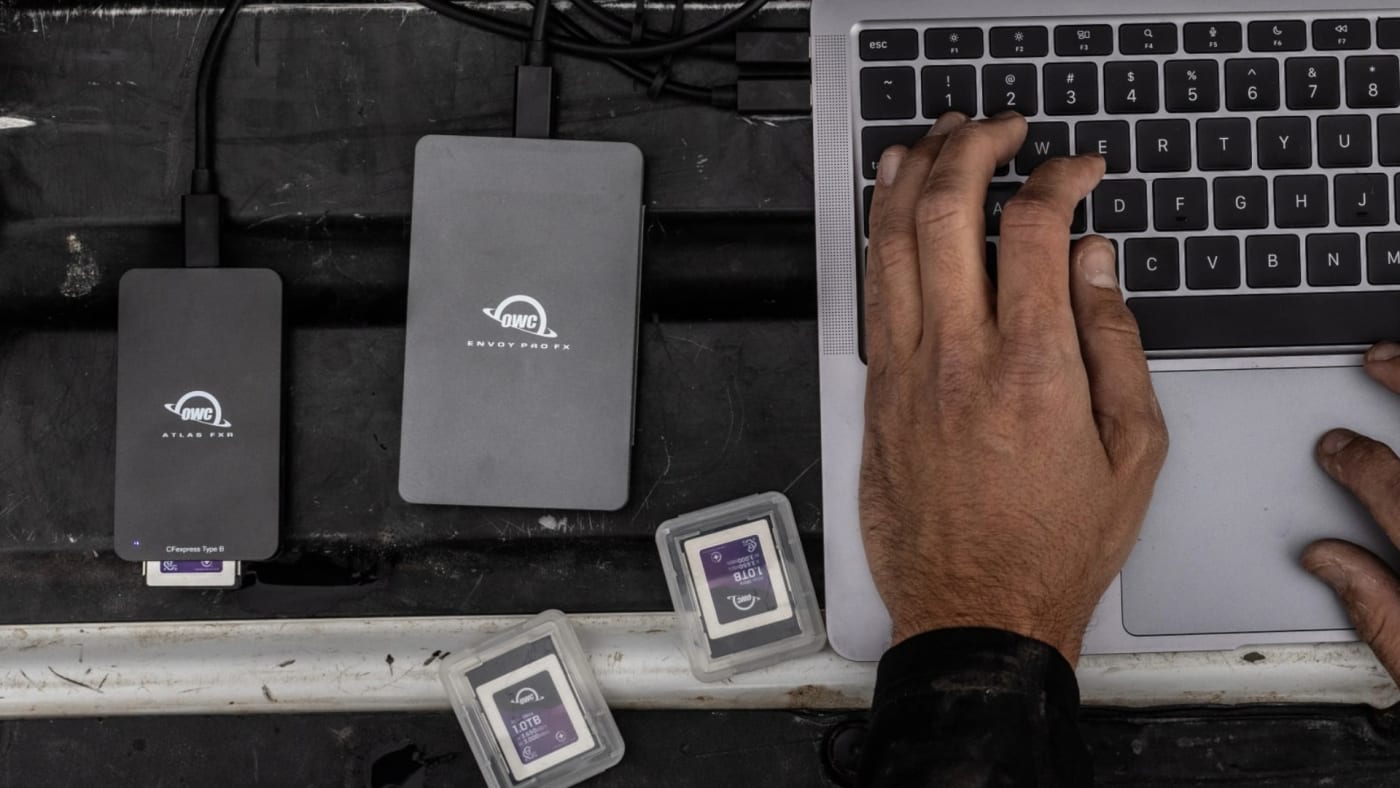
2. Complete shock and impact resistance
Real drop and impact protection begins with a solid, well-designed enclosure — one where the internal components are properly secured and where the chassis itself can absorb and distribute force. OWC’s drive enclosures are engineered with this in mind, providing genuine, thorough structural protection without relying on an external shell to do the job.
3. Built like a tank
All of OWC’s rugged SSDs are IP67 rated, making them dustproof and waterproof. And each features a heat-dissipating aluminum chassis that shakes off drops, stomps, and the odd moment of being run over by a truck.
4. All in a slim, portable form factor
But here’s the kicker: real-world ruggedness doesn’t mean big and bulky. The professionals who depend on these drives often operate in space-constrained, weight-sensitive environments. That’s why OWC’s rugged drives maintain a slim, portable profile without sacrificing the structural integrity that makes them field-ready.
The OWC Rugged Drive Lineup
OWC’s field-proven rugged SSDs are engineered for the professionals who can’t afford a failure. Each drive is designed to be slim, fast, extremely durable, and built to last for years and years.
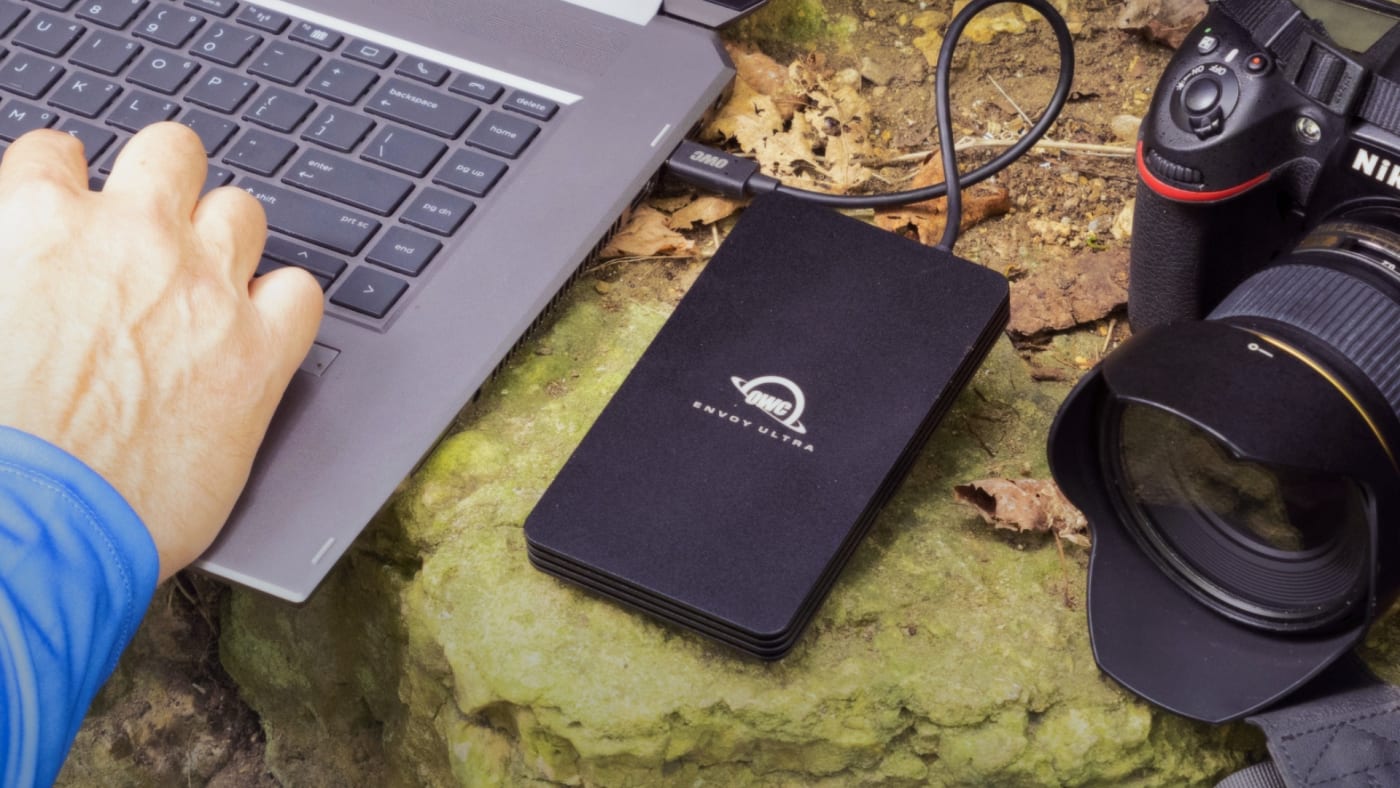
OWC Envoy Ultra
The Envoy Ultra is OWC’s flagship portable SSD and the company’s first Thunderbolt 5 drive. It’s also the fastest bus-powered external drive ever made.
With real-world transfer speeds exceeding 6,000MB/s, it delivers up to twice the throughput of Thunderbolt 4 and USB4 drives, making it capable of handling the most demanding professional workflows: editing 8K and 12K lossless video, moving hundreds of gigabytes of camera originals in minutes, or matching the performance of a host machine’s internal storage.
Rugged credentials are built into the design from the ground up. The Envoy Ultra is IP67 rated and is waterproof, dustproof, and crushproof, with a fanless aluminum housing that passively dissipates heat for sustained performance under load. A captive integrated Thunderbolt cable—which means you’re never hunting for a cable in the field—also enables the waterproof rating and allows for precise tuning of the flash storage. It’s backward compatible with Thunderbolt 3, Thunderbolt 4, and USB4 devices, meaning it delivers the full speed of whatever machine you plug it into.
Envoy Ultra is available in 2TB, 4TB, and 8TB capacities—the 8TB model is the first and only Thunderbolt 5 drive of its kind at that capacity.
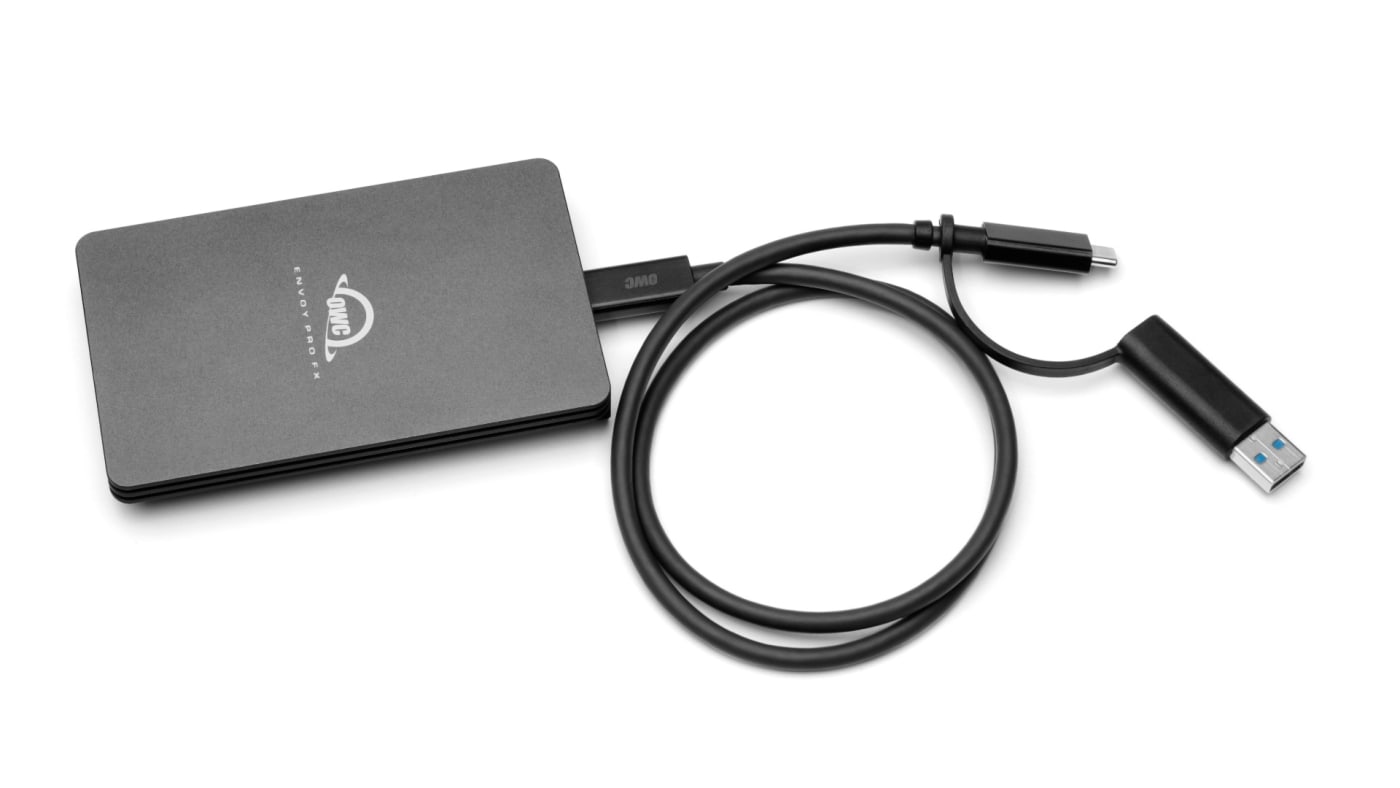
OWC Envoy Pro FX
The Envoy Pro FX is the universal Thunderbolt portable SSD. With real-world transfer speeds of up to 2,800MB/s, it’s fast enough for in-field editing of large-format video and high-volume RAW stills. And it comes with a certified OWC Thunderbolt cable and a tethered USB-A adapter so it works with just about any device you’d want to connect it to, right out of the box.
The FX is IP67-rated and it’s MIL-STD-810G certified for military-level drop toughness, having been independently tested with over 25 drops at every angle from four feet. Its grooved, aluminum chassis is engineered as a heat sink, keeping the drive silent and cool even during prolonged high-speed transfers. This drive has even flown to space aboard Blue Origin’s New Shepard rocket.
Check out the Envoy Pro FX here.
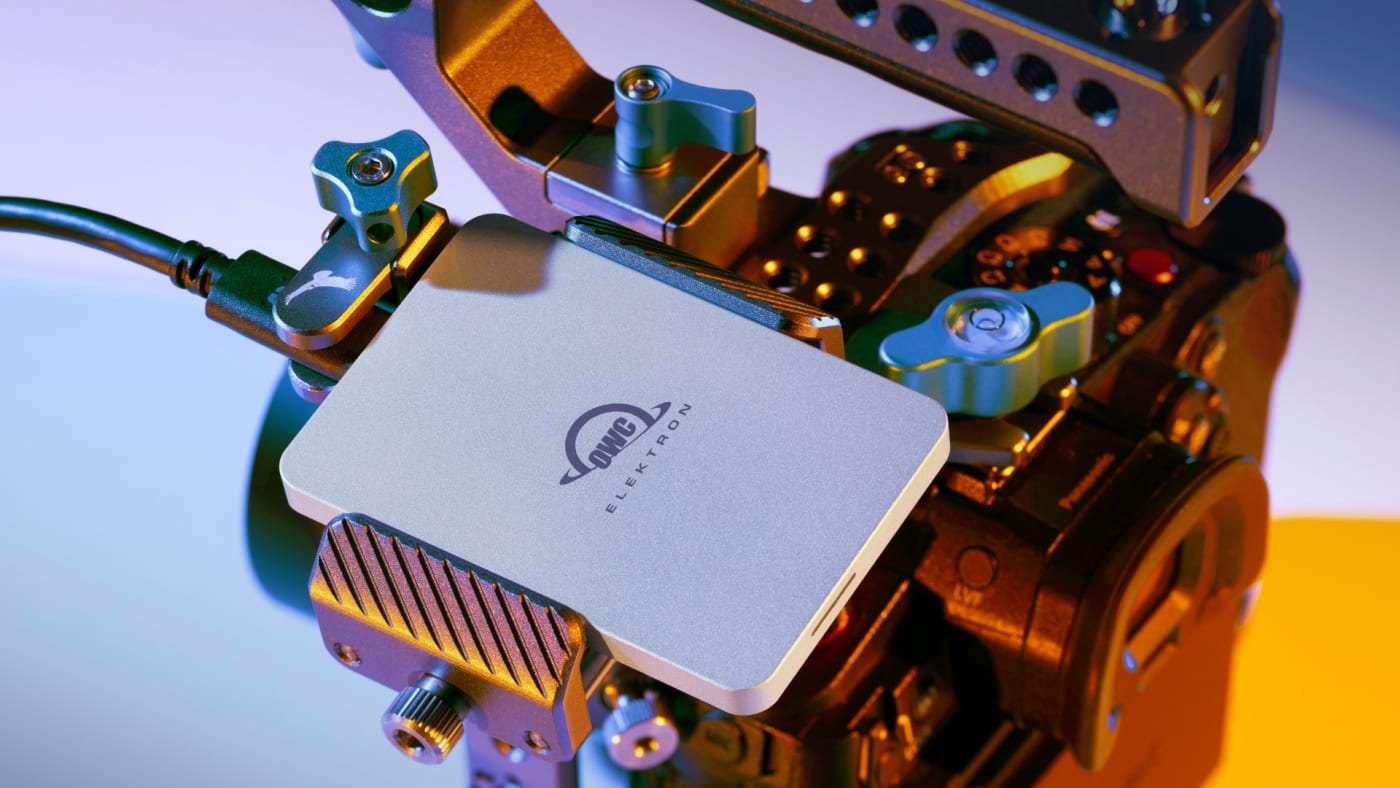
OWC Envoy Pro Elektron
The Envoy Pro Elektron is the smallest drive in the lineup—a pocket-sized USB-C SSD that pushes the USB-C interface to its limit while surviving just about anything the field can throw at it. Like the Envoy Ultra and FX, the Elektron is IP67-rated and built from the same aircraft-grade aluminum chassis design that makes OWC’s drives such effective heat sinks. It delivers real-world transfer speeds of up to 1,011MB/s, making it it up to twice as fast as other portable SSDs in its class.
The Elektron is purpose-built for maximum portability without compromise. It’s smaller than a pack of cards, available in capacities up to 4TB, and works natively as a direct recording drive for USB-C-equipped Blackmagic, Fujifilm, and Panasonic cameras—enabling instant ingestion in the field, skipping the card reader entirely. For creators who need rugged storage in the tightest possible package, or who want a drive that works seamlessly with their camera body on location, the Elektron is the answer.
Tested Where It Counts: Three Creators, Three Extreme Environments
We can detail our drives’ rugged bonafides all day. But we think the most compelling testimony for a field drive isn’t a spec sheet. It’s the people who take it into the places that would kill a lesser piece of gear.
So, don’t take it from us. Here are the ways three creators are taking OWC gear to the ends of the Earth, pushing these drives to the limits on glaciated mountain faces, beneath the ocean’s surface, and deep in sun-blasted desert terrain.

Frosted Peaks: Renan Ozturk
As we detailed before, few people on earth push their gear to the extremes that Renan Ozturk does. As a result, few artists have the body of work that Ozturk has built. His film Meru garnered several awards, including the 2015 Audience Documentary Award at Sundance. He was named National Geographic Adventurer of the Year in 2013, and today Ozturk works as a commercial and documentary filmmaker for clients including The North Face, National Geographic, and Sony, telling stories from some of the most remote and demanding environments on the planet.
His shoots take him to altitudes where battery life shrinks, cold turns mechanical equipment sluggish, and every piece of gear is subjected to stresses that are difficult to simulate in a lab. For Ozturk, a drive that fails isn’t just an inconvenience—it can mean losing footage that was captured at serious personal risk.
Ozturk says OWC gear “gives you more energy to actually focus on the story. More than anything that’s what keeps you safe, keeps you alive and brings these images back that sometimes you’re risking your life for.” He adds “It’s all of these things that OWC has been pushing from the beginning that really comes in for the win and that’s the honest truth.”
Ozturk relies on OWC Atlas Ultra CFexpress Type B memory cards that combined lightning fast performance, support for even the most bleeding edge camera settings, and capacities up to 2TB for all-day shooting. Ozturk is also a big fan of the OWC Envoy Elektron, the drive that can fit in just about any camera bag pocket.
“If your workflow is dialed, if you know how to safely backup your data and invest not only in your camera but in your hard drives, in the cards that you’re putting in your camera, that’s just as important as everything else,” Ozturk says. “Because it gives you more energy to actually focus on the story — more than anything, that’s what keeps you safe, keeps you alive, brings these images back that sometimes you’re risking your life for.”
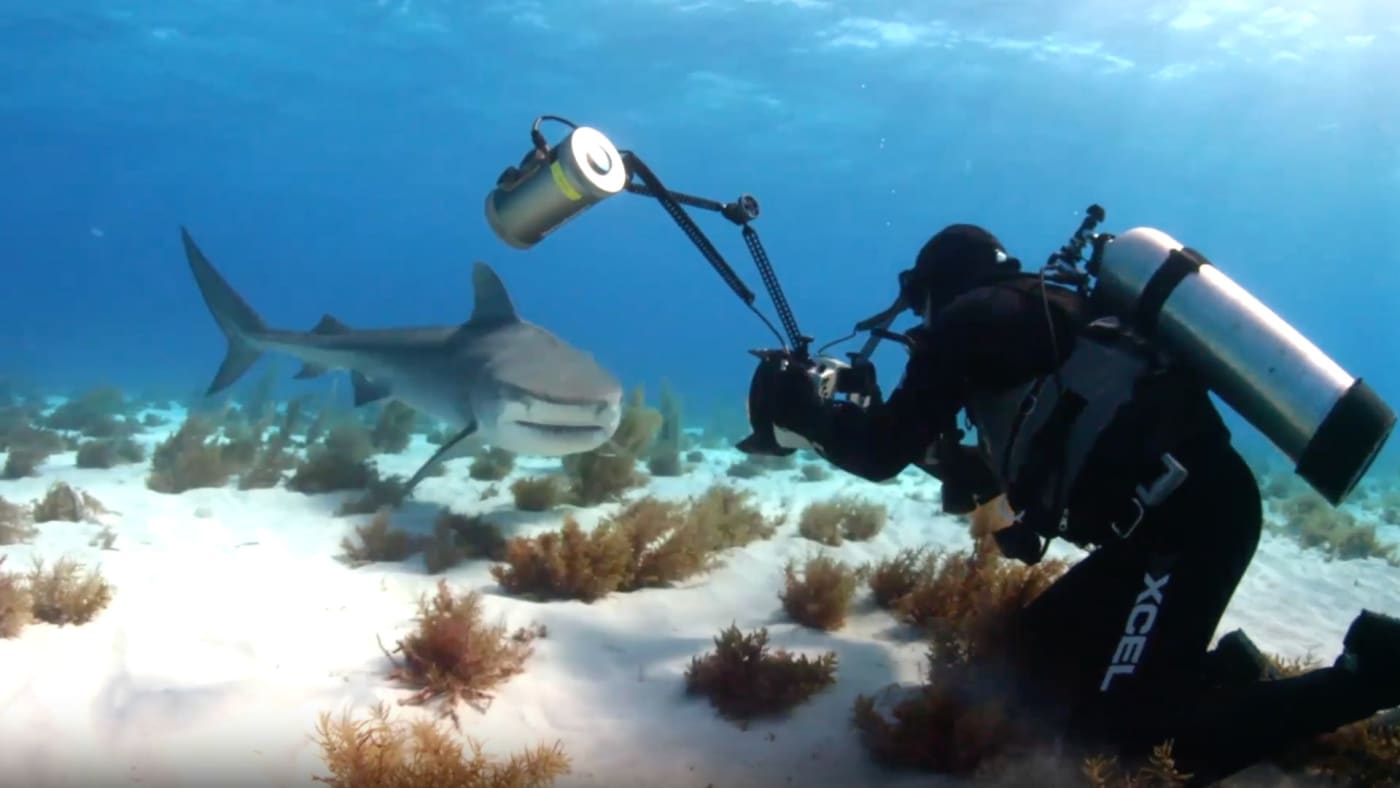
The Depths: Brian Skerry
Brian Skerry is one of the most celebrated underwater photojournalists and filmmakers in the world. A 27-year contributor to National Geographic magazine and Partners, Skerry has logged roughly 15,000 hours beneath the ocean’s surface documenting marine wildlife, from orca families off New Zealand to sperm whale calves in Dominica to sharks in waters around the globe.
His documentary series Secrets of the Whales, produced for Disney and National Geographic, took him to 24 locations from the equator to the poles over three years.
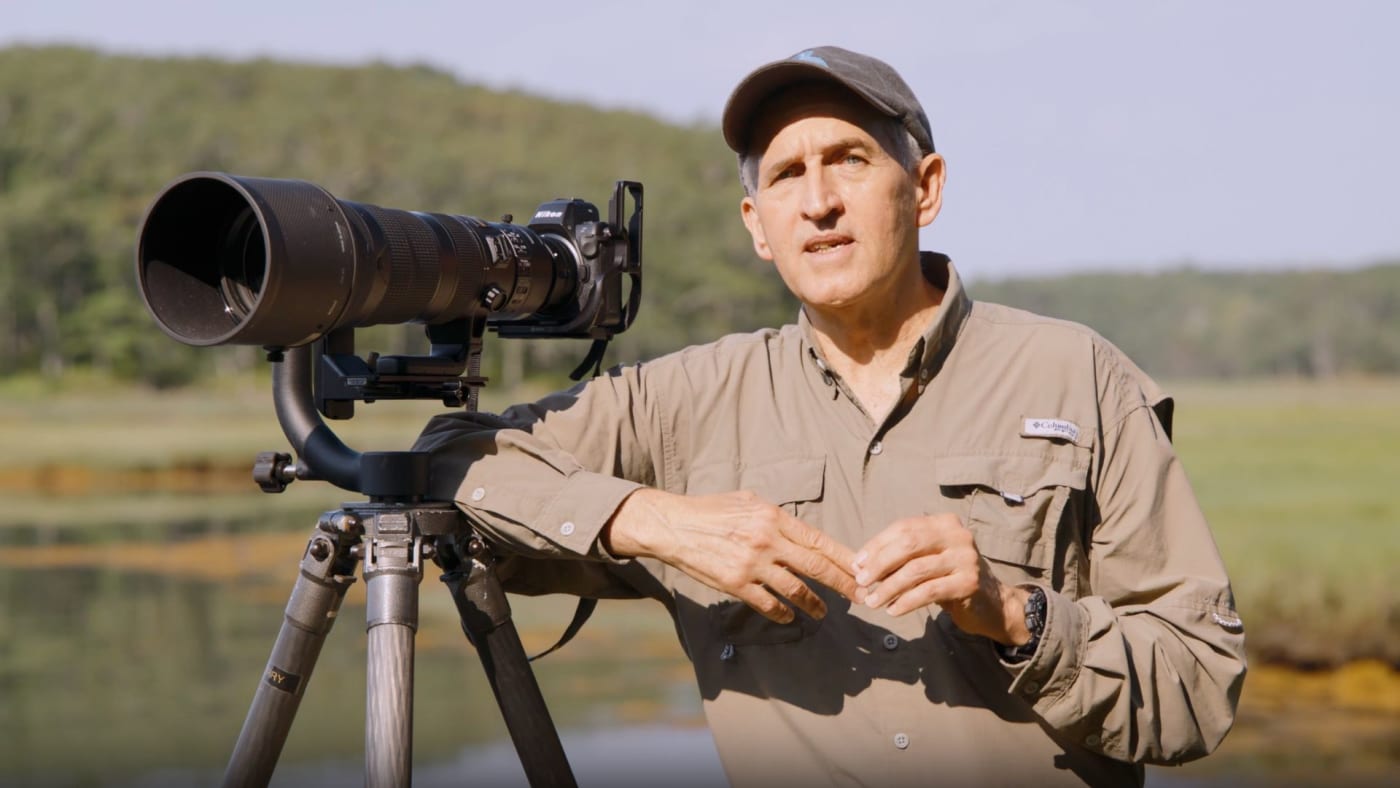
A field day for Skerry typically runs 15 to 16 hours, often beginning before sunrise and ending with hours of offloading and editing back in whatever cabin, boat, or hotel room serves as his studio for the night. When he’s shooting film with a larger crew, the volume of data is enormous—as are the consequences of a storage failure.
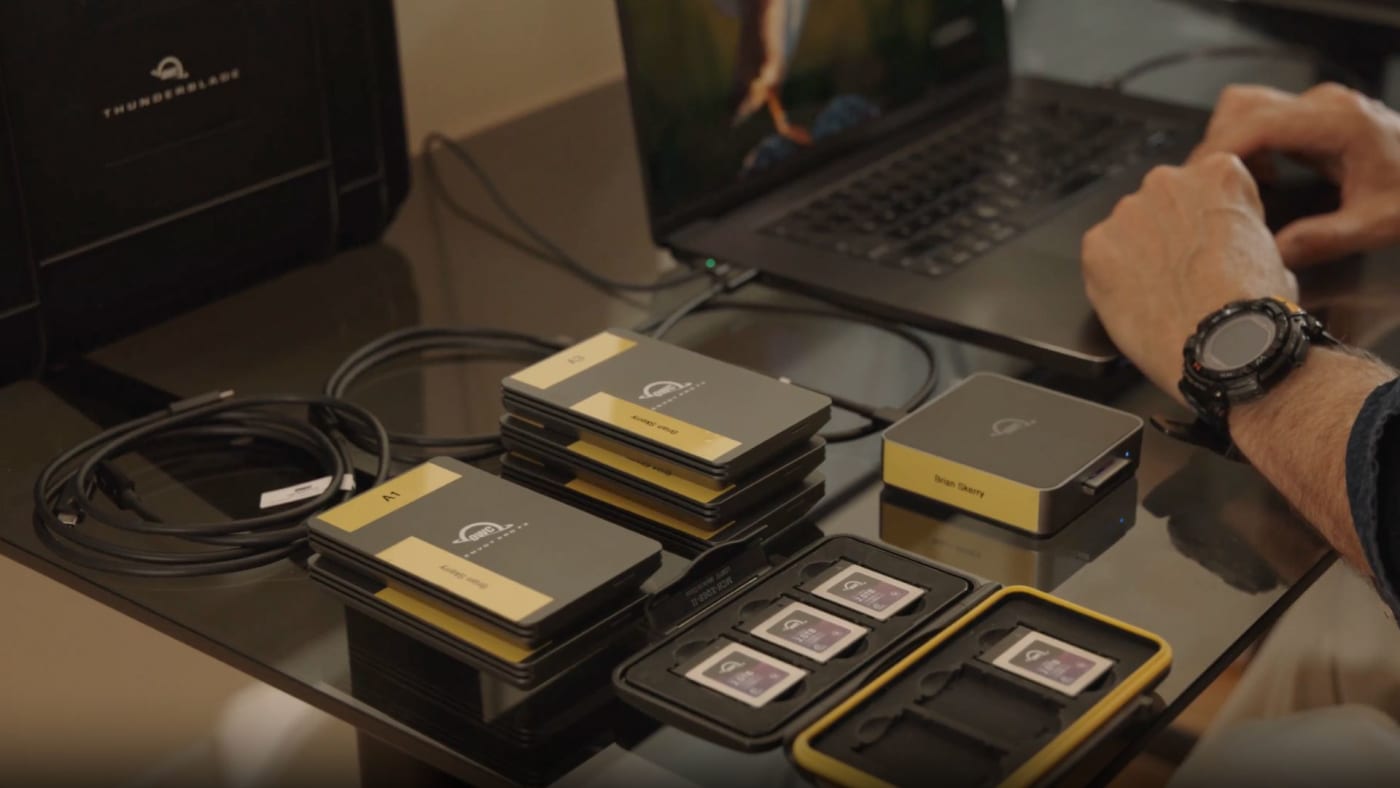
After fully migrating to a full OWC photography ecosystem comprised of Atlas Ultra CFexpress Type B cards, the OWC USB4 CFexpress Card Reader, and the OWC Envoy Pro FX, Skerry says the difference was immediate and dramatic. Where he used to set alarms to wake up through the night to swap out drives during long transfers, he no longer has to.
“It’s not unusual for me to work 16-hour days or longer on location,” he explains, “and with the amount of data we’re producing these days, this used to mean staying up most of the night as well. Not anymore.”
In the field, Skerry trusts his offloads to Envoy Pro FX SSDs. “Once you’ve tried it,” he says, “there’s simply no going back.”

Shifting Sands: Nick Cahill
Nick Cahill is an adventure filmmaker and photographer who, in his own words, “likes to take cameras where most people don’t like to go.” Based in the Lake Tahoe region, Cahill has built a career shooting in some of the most demanding physical environments a camera can encounter, including: the sun-scorched desert tracks of the Baja 1000 off-road race in Mexico, the powder-covered peaks of extreme ski destinations, and the sweeping night skies of remote wilderness locations.
His photograph of the Milky Way over Lake Tahoe graced the cover of National Geographic’s “Guide to the Night Sky” issue in 2015.
Dust and moisture are constants in Cahill’s work environments, and the high-capacity data demands of shooting 6K video on a RED Komodo alongside 45MB RAW stills on a Canon R5 mean that slow, unreliable storage is a bottleneck and liability. “A lot of my jobs are like mini expeditions,” he says.
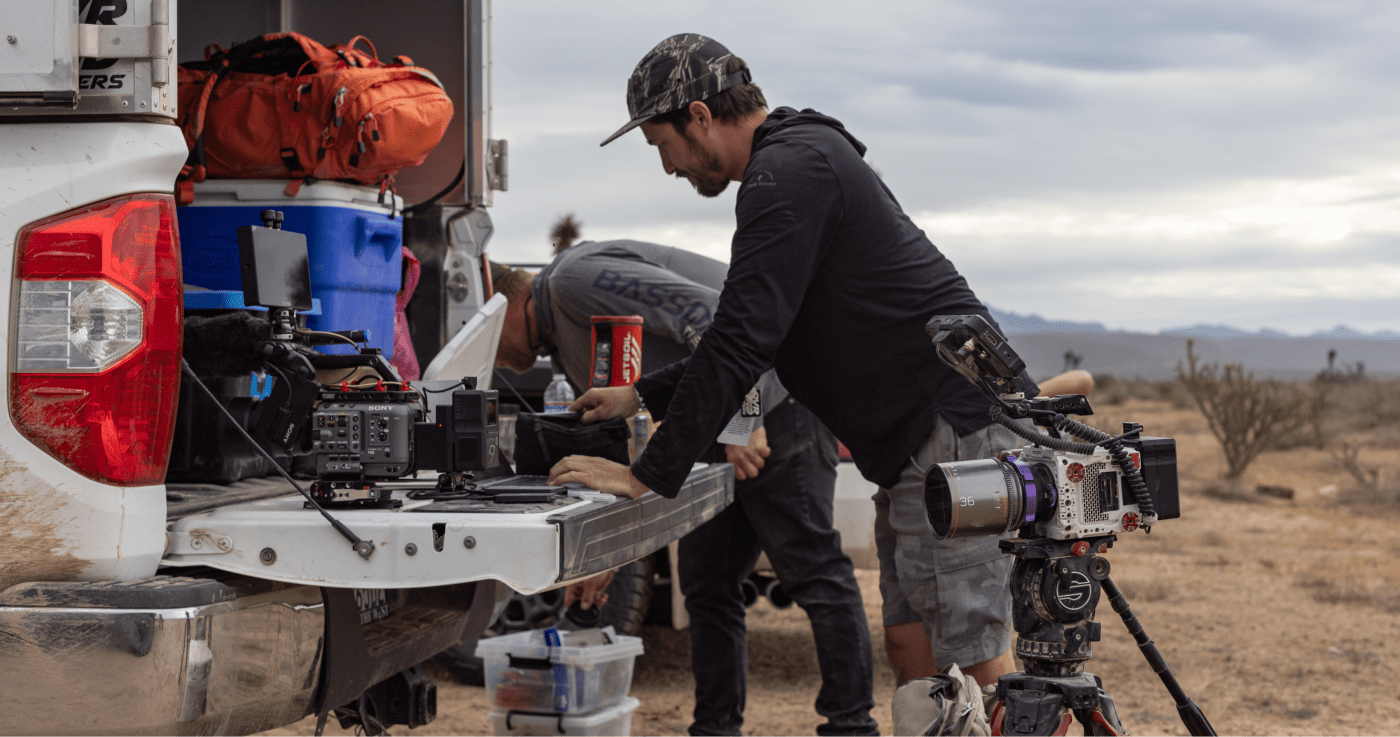
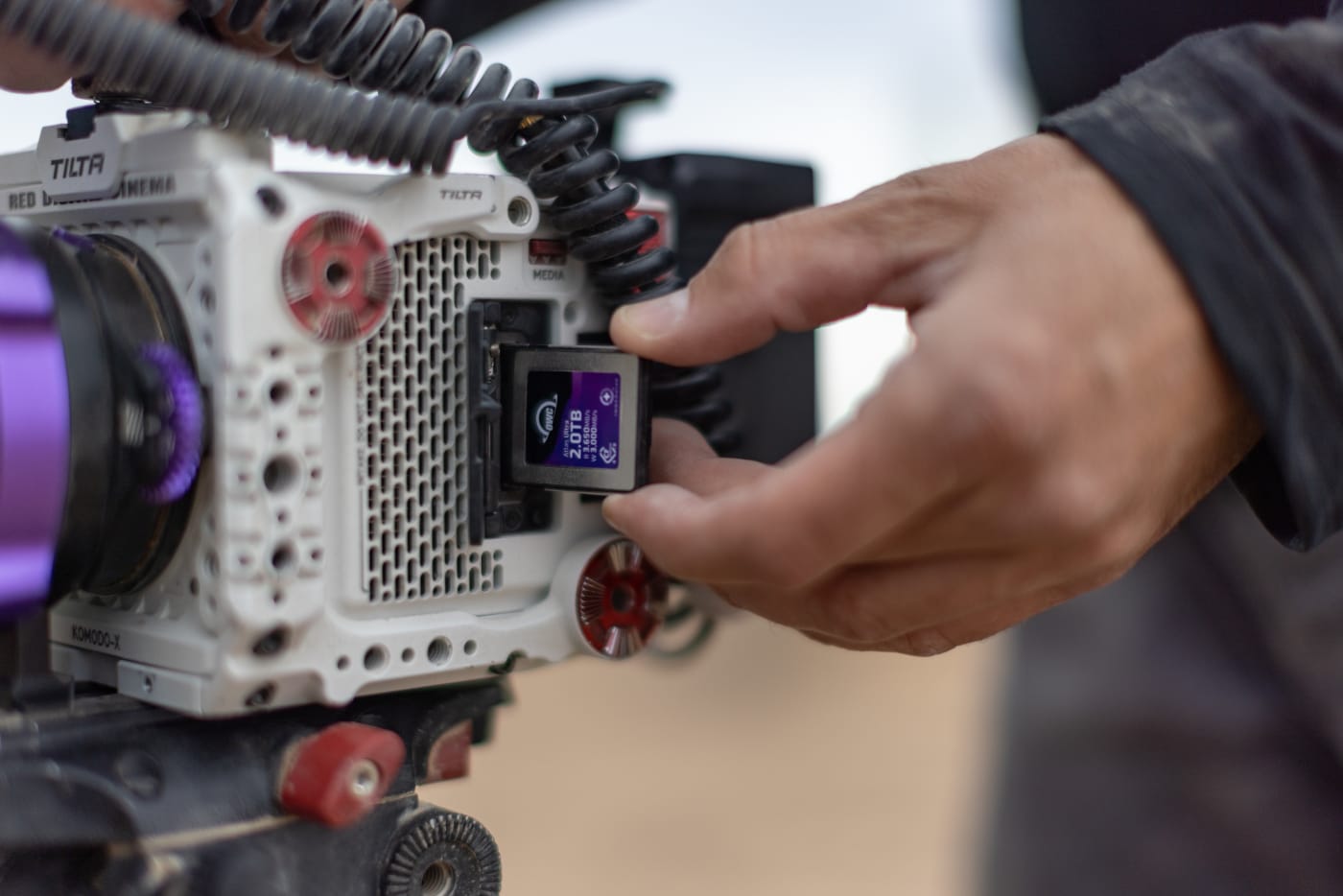
After switching to OWC’s end-to-end storage ecosystem—including OWC Atlas Ultra CFexpress Type B cards, the Envoy Pro FX, the ThunderBlade, and ThunderBay 4 RAID—Cahill found himself watching a progress bar in near-disbelief.
“I recently moved 7.5TB from one system to the other in like 90 minutes,” he says. “With that recent transfer I remember I literally, for like 30 minutes, just watched the bar go because I didn’t believe it was going that fast.”
“Time is the one thing you can’t buy,” Cahill adds. “I’m a car guy, so I look at memory cards and SSDs like cars. I used to use the Honda Civic of drives. But now I use the Formula 1 car of drives with OWC.”
Other topics you might like

How to Maximize Your New M5 Max and M5 Ultra Mac Studio: Storage, Docking, and Connectivity
Updated on Sep 16, 2026


Get the Most Out of the New M6 and M5 Pro Mac mini with These Docks and Drives
Updated on Sep 3, 2026
How to Choose the Right Desktop Storage: Capacity, Speed, and Interface Explained
Updated on Sep 2, 2026