 USA + International
 OWC Canda
 OWC Europe
SD vs. CFexpress: Should You Upgrade Your Memory Card?
Wondering if you should invest in an upgrade from SD cards to CFexpress? We break down the differences between the two formats and when it makes sense to upgrade.
Wayne Grayson • Aug 11, 2026
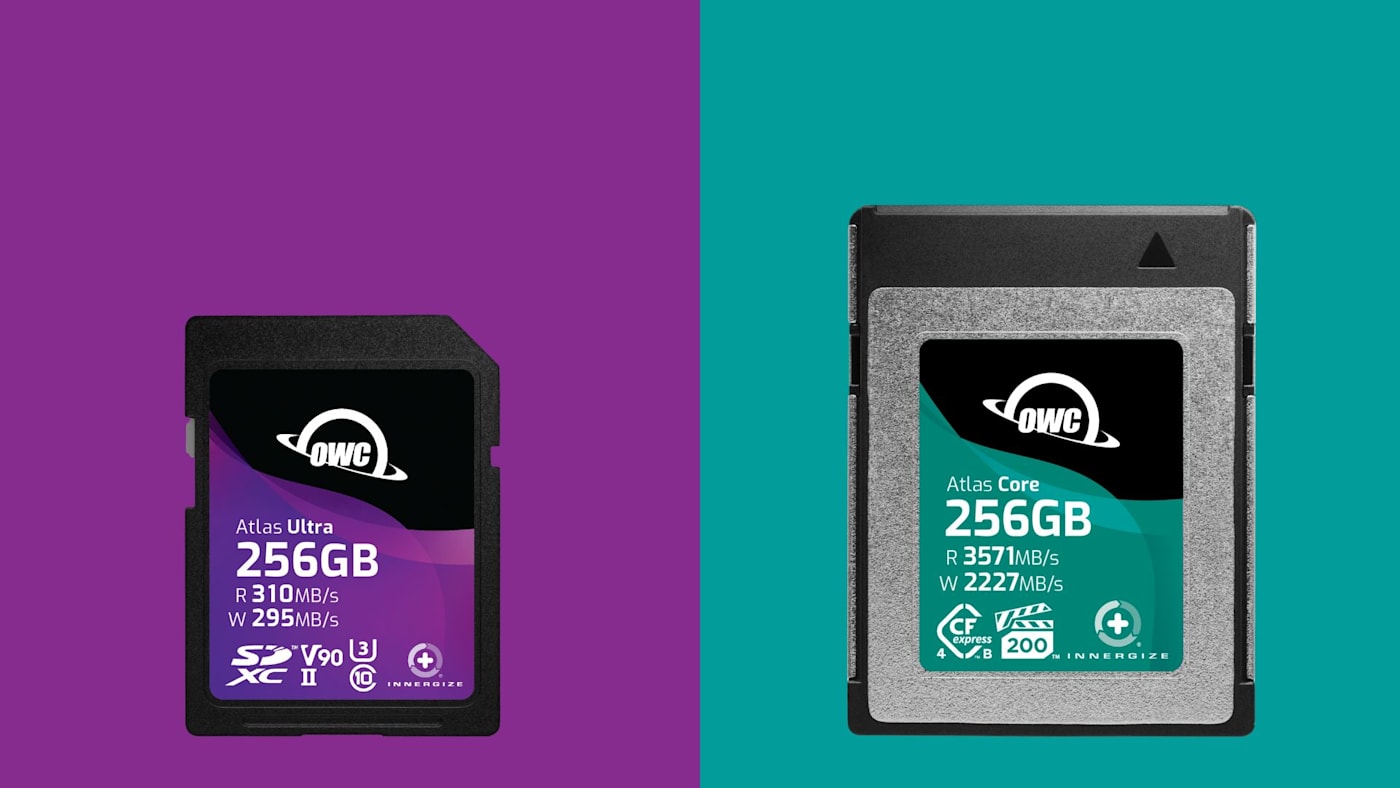
CFexpress memory cards aren’t just faster than SD cards. CFexpress cards are much, much faster than SD cards. We’ll get into the specifics shortly, but we wanted to get that aspect of this choice out of the way quickly.
The thing is, you might not have a need for all that speed. There’s a reason that lots of cameras only support SD cards. And most of the ones that support CFexpress offer that support in addition to SD cards. So, let’s talk about whether upgrading to CFexpress makes sense for your workflow or if you’re just fine sticking with SD cards.
CFexpress is a Whole Different Beast
The first thing to know about SD cards and CFexpress cards is that they are built atop entirely different interfaces.
While SD cards are built on a more limited interface, CFexpress cards are built on the same NMVe protocol and PCIe interface used in modern solid-state drives (SSDs). Because of that, CFexpress cards can tap into bandwidth and data speeds that dwarf those of SD cards.
The OWC Atlas Ultra is among the fastest SD cards on the market. With 300MB/s read and 295MB/s write speeds and V90 II certification for 90MB/s sustained speeds, you can’t do much better when it comes to choosing an SD card.
But compared to the Atlas Core CFexpress Type B memory card, our entry level CFexpress Type B card, the Atlas Ultra V90 II simply can’t compete. Atlas Core delivers speeds up to 3,571MB/s read and 2,227MB/s write, making it as much as 10x faster.
Even when you limit a CFexpress card to a single PCIe lane, the comparison to SD cards isn’t fair when it comes to pure performance. CFexpress Type A cards are smaller than Type B and only support a single PCIe lane. Despite that limitation, our Atlas Pro CFexpress Type A card delivers top speeds up to 1,850MB/s read and 1,700MB/s write—6x the top speed performance of the fastest SD cards.
Sustained Speeds are the Real Differentiator
But top speeds don’t tell the whole story with this comparison. The more impactful separation between SD cards and CFexpress cards comes with sustained speeds. These are the speeds you can rely on when shooting burst RAW photography and high resolution video. While the Atlas Ultra V90 II SD card can reach sustained speeds of 90MB/s, the Atlas Core quadruples that sustained performance with 368MB/s sustained write performance.
Meanwhile, our OWC Atlas Ultra CFexpress 4.0 Type B is our fastest Type B card, delivering 3,650MB/s read and 3,000MB/s write capability with sustained write performance of a whopping 1,500MB/s.
So, it all comes back to the fact that CFexpress cards are built atop PCIe. That foundation is what allows CFexpress to sustain dramatically higher write speeds over long periods, which is exactly what modern 6K and 8K RAW and high-frame-rate video formats and high-speed RAW burst photography demand. Some current camera bodies like the Nikon Z9 and Canon EOS R1 have dropped SD slots entirely because of this.
And remember, the faster speeds of CFexpress don’t just come through when you’re using your camera. When combined with a fast card reader such as the Atlas CFexpress Card Reader, CFexpress cards put all that speed to use in getting your images and video off their card and ready to edit and/or backup much faster than SD cards. We’re talking the ability to offload half a terabyte of assets in as little as several minutes.
When to Stick With SD Cards
- If you shoot primarily stills and don’t rely on burst shooting, SD cards are more than suitable for your shooting style.
- Even if you shoot high resolution RAW in moderate-length bursts, or are shooting standard 4K video SD cards can keep up just fine while shooting.
When To Upgrade to CFexpress
- You’d like your footage to offload faster: You might not need CFexpress performance while shooting, but everyone can benefit from getting their images and video off their memory card and onto their editing device or drive faster. Thanks to CFexpress cards’ higher bandwidth, you’ll see your offload and backup wait times decrease dramatically over an SD-based workflow.
- You record 6K or 8K RAW and/or high-frame-rate video: The data rates involved in high resolution and high frame rate RAW routinely exceed what SD can sustain without dropped frames.
- You shoot fast, continuous, high resolution still photography bursts in RAW: Modern mirrorless bodies shooting 20fps or faster in RAW will fill an SD card’s buffer and start throttling far sooner than a CFexpress card would.
- You work with cinema-oriented codecs: ProRes RAW, R3D RAW, and Blackmagic RAW at high bitrates are workflows CFexpress was specifically built to sustain.
How to Choose the Right CFexpress Card For Your Needs
Once you’ve decided CFexpress is worth the upgrade, OWC offers four cards spanning entry-level value to top-tier cinema performance:
OWC Atlas Pro CFexpress 4.0 Type A is the card for Sony shooters. With a VPG200 certification, the card delivers up to 1,850MB/s read and 1,700MB/s write along with sustained write of 400MB/s, comfortably covering Sony’s current RAW photo and video demands, in capacities up to 960GB.
OWC Atlas Core CFexpress 4.0 Type B is the newest and most affordable card in the lineup, built for hobbyists, hybrid shooters, and content creators stepping up from SD cards who don’t need the absolute top tier of performance. At 256GB with speeds up to 3,571MB/s read and 2,227MB/s write, and a 368MB/s sustained write, it comfortably handles high-burst RAW photography and 4K video, plus compressed 8K. It’s the right choice if you shoot Canon R-series, Nikon Z-series, Fujifilm GFX, or Panasonic S-series and want CFexpress performance without paying for headroom you won’t use.
OWC Atlas Pro CFexpress 4.0 Type B is the mainstream professional choice, and where most working photographers and videographers shooting Type B cameras should land. It steps up to 3,650MB/s read, 3,000MB/s write, and a 800MB/s sustained write rate — more than double Atlas Core’s sustained throughput — making it the right fit for higher-resolution video workflows, extended RAW bursts, and professional work where Core’s ceiling starts to feel close.
OWC Atlas Ultra CFexpress 4.0 Type B is built for the top end of the market with sustained write speeds of 1,500MB/s minimum, nearly double the Atlas Pro Type B’s sustained rate. This is the card for dedicated cinema cameras like the RED V-Raptor, extended 8K RAW capture, and any workflow where dropped frames during a long take simply aren’t an option.
Other topics you might like


How NRG Recording Studios is Bringing its Historic Archive Into the Modern Era
Updated on Sep 22, 2026

OWC SoftRAID 9 Brings RAID 6 Protection to Mac and Windows, Introduces RAID 6+
Updated on Sep 21, 2026

How to Maximize Your New M5 Max and M5 Ultra Mac Studio: Storage, Docking, and Connectivity
Updated on Sep 16, 2026